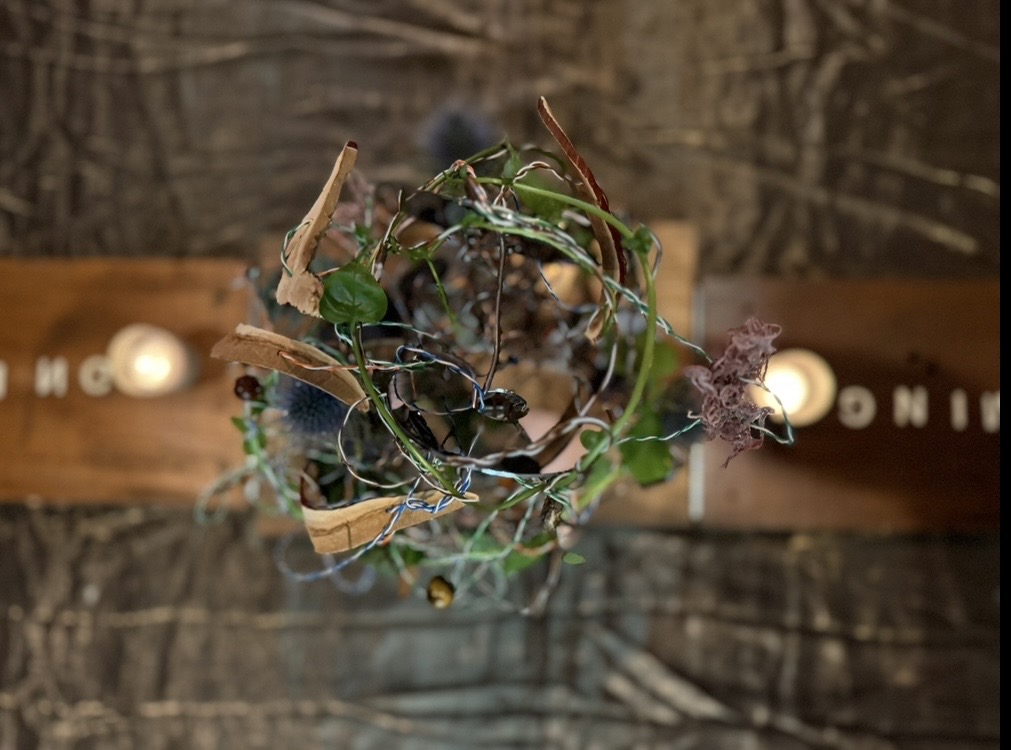
My decades as an hourly consultant have conditioned me to calculate the monetary return of any time investment almost subconsciously. So, when I was asked to create an art installation, my first thought was “I don’t have time for this”.
As in I can’t spare the time because billable hours should always take priority.
But at the time, I also had a once in a lifetime pile of objects about my abode. I’d just finished an archiving project for an artist whose house had burned down some years back, but whose hard drives containing the masters of all their recordings miraculously survived the fire.
Spin platter “old school” hard drives are less used now, and I was about to recycle a pile of them, so I thought: “When’s the next time you’ll get to pull those cool looking read heads and shiny platters out of a bunch of drives?”
So, I said yes to creating the installation.
The prompt was “Becoming”.
It made me think of how we put things into categories. Hard drives are “dead technology”. Plants are “living things”, “weeds”, “food”.
Art is usually not made of either.
And it made me think of the lifecycle of these particular hard drives. How they were made, bought to store the only copies of an artist’s life’s work. How, for that time, their lifeless form was imbued with an intangible value that caused the artist, as they fled their burning house with nothing but the literal shirt on their back, to pray something of their life’s work would survive.
And how — by nothing short of a miracle — only that room in the house didn’t burn to ash, and was not soaked by firefighters.
The scraggly boxes were brought to me covered in soot.
Some of the drives needed a little help, but nearly all of the data came off them intact.
Once that they had performed their miracle, I thoroughly erased the drives. Overwrote every formerly meaningful block with random data. Making them, once again, lifeless — and most literally, meaning-less.
Stripped of their recording studio markings and labels, the empty shells were now ready for recycling.
It made me think about where the drives would end up and what lived there.
I imagined weeds intertwined with the rusted, bent drive heads someplace “away”.
In addition, I had some computers that were no longer viable in today’s rapidly changing technological landscape. Ten years old is ancient, even for a formerly top of the line machine. The churn of material. Of energy. Of discards.
I opened some of them up, searching for cool looking parts.
A speaker here, a wifi antenna there. A CPU heat sink. A hinge.
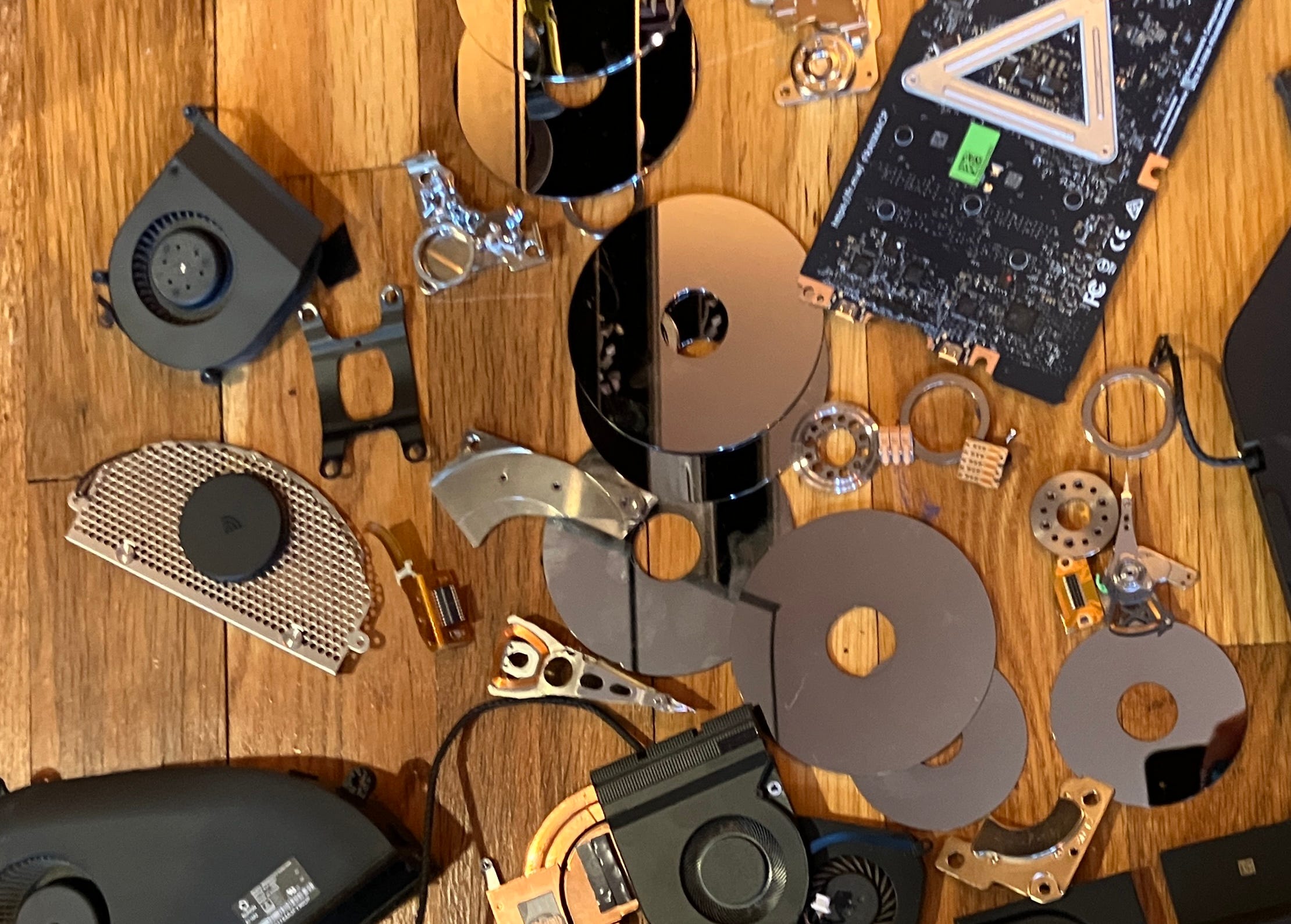
I’ve always been fascinated by the way modern devices look on the inside. It’s a different world in there from the sleek, “best foot forward” external shell. You can tell which electronics had been designed for easy repair versus those the manufacturer would rather you replace at the first malfunction. Some you can take apart intuitively, because the inner layouts make sense. Others are head scratchers. Labyrinths of poor engineering and little concern for the future.
I imagine a machine that would come apart neatly into all the separately reusable/recyclable components. I have yet to meet one that does. I would gladly take apart the machines I use for better recycling.
I wanted to build some sort of “fluid” frame to contain the scavenged mechanical parts. I wanted it to look alive, as if it had grown, not been assembled.
Then, one of my plants caught my eye.
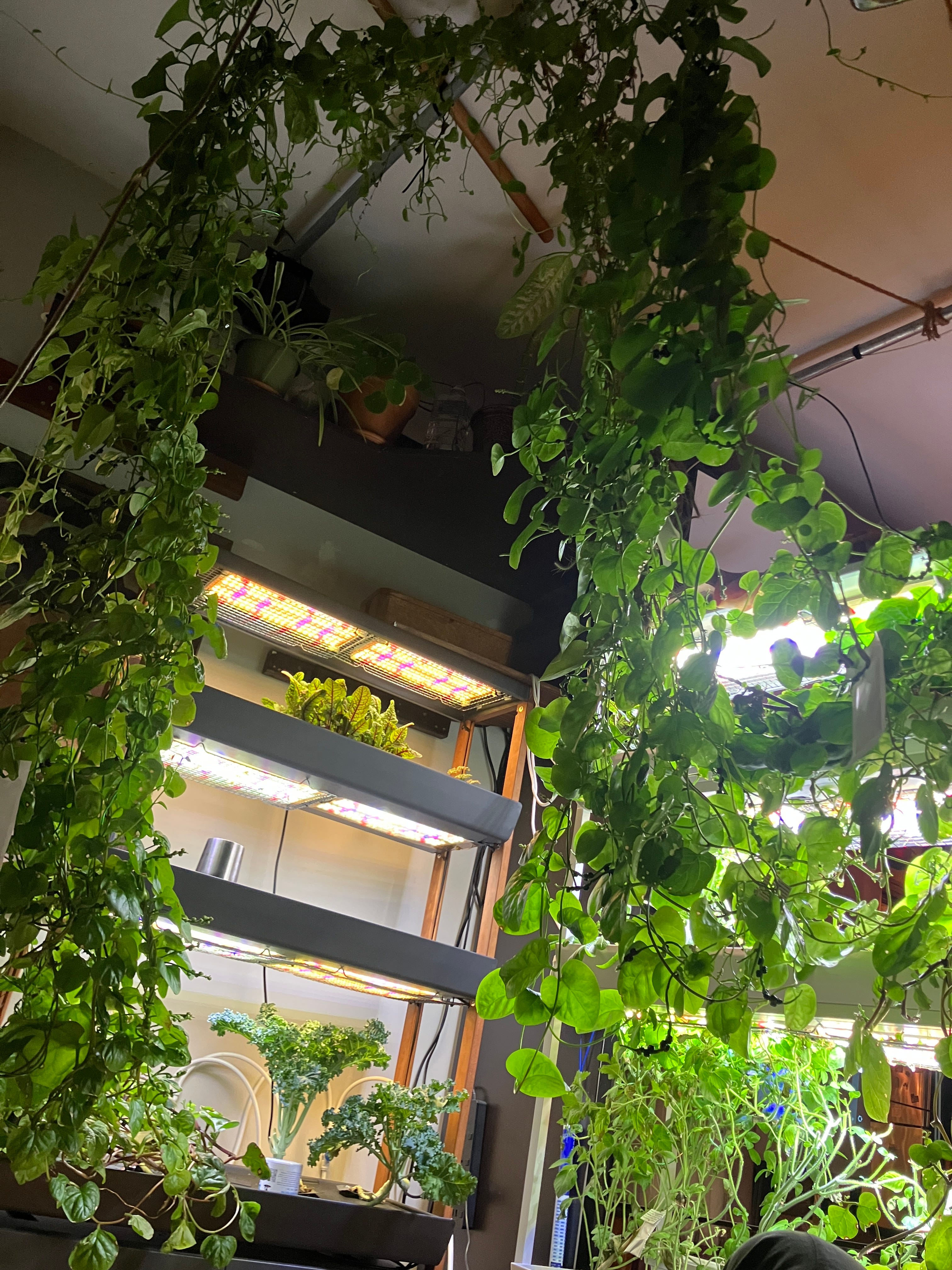
I had been playing with bonsai wire lately, to guide vining Malabar spinach plants towards my ceiling and offer structure to a droopy pride of India tree. Then I kind of started using it all over the place. To hold air ducts. To make little hooks to attach ankle straps to a pair of stilettos that kept sliding off my heels.
So I took a block of wood and fastened it to a small pedestal. Put in some angle brackets and looped bonsai wire through the screw holes. OK. This looked like a bizarre antenna, all crooked and wobbly.
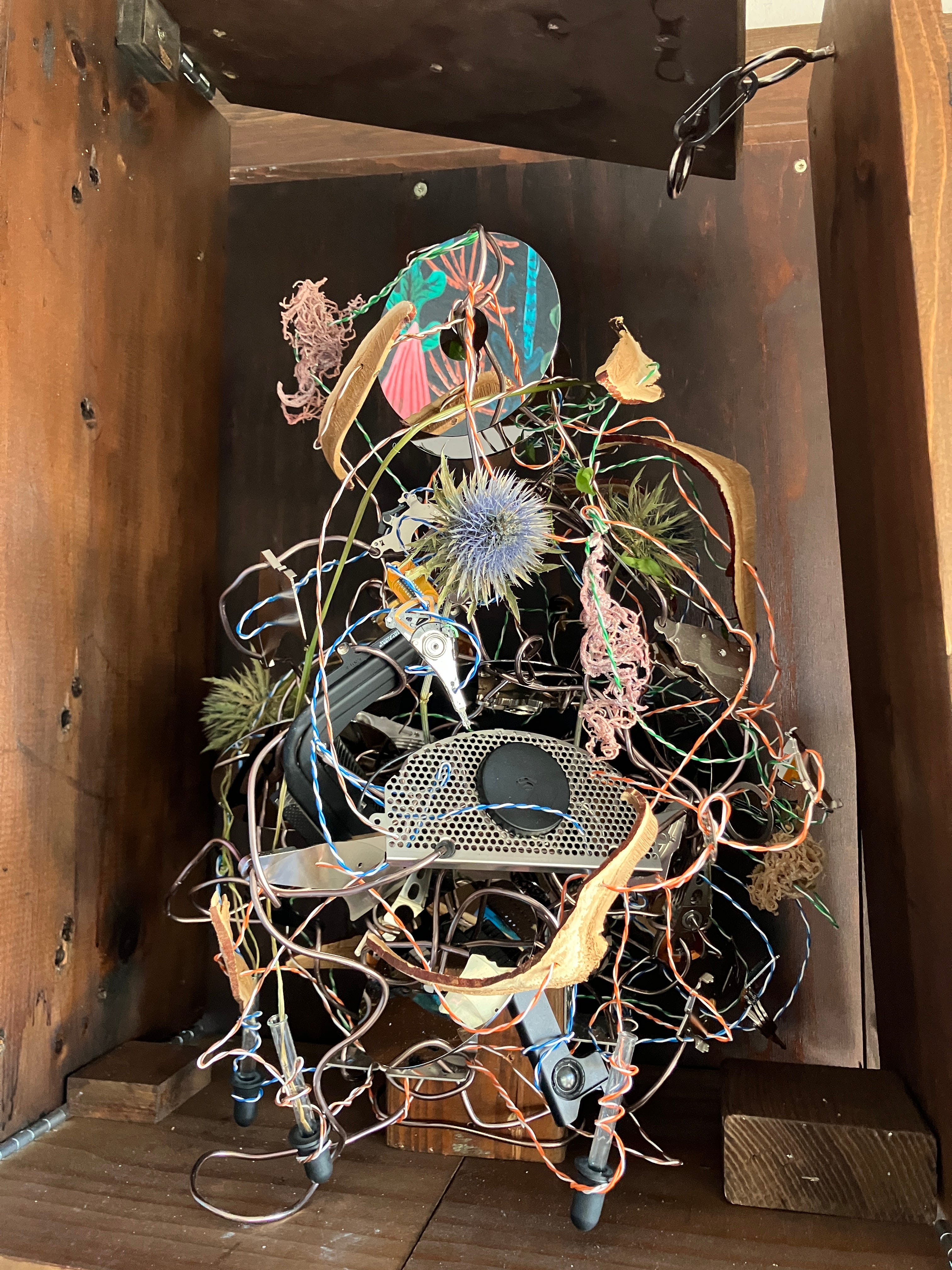
Then I began threading hard drive and computer parts onto the bonsai wire. Spinning up and up in a spiral, weaving in and out. Using the hard drive magnets to “pin” bits together. I felt like a kid doing this, guided by a randomness that we seldom get to channel when making things. Usually, there is a purpose, a problem to solve.
What emerged looked like a robot vomited their innards into a pile after a bad meal. Kind of organic looking, but still all composed only of shiny metal forms. All dead.
Then, I remembered I had some herbal provisions, too old for medicinal use, so I sliced up some Ethernet cable and wove it through the bonsai wire, pinning reishi mushroom slices, sea moss clusters and nettle blooms through the structure.
Now, it began to feel closer to what I was hoping for.
It began to look like it grew from the ground like that, on an Earth where hard drive parts grew on thorn bushes.
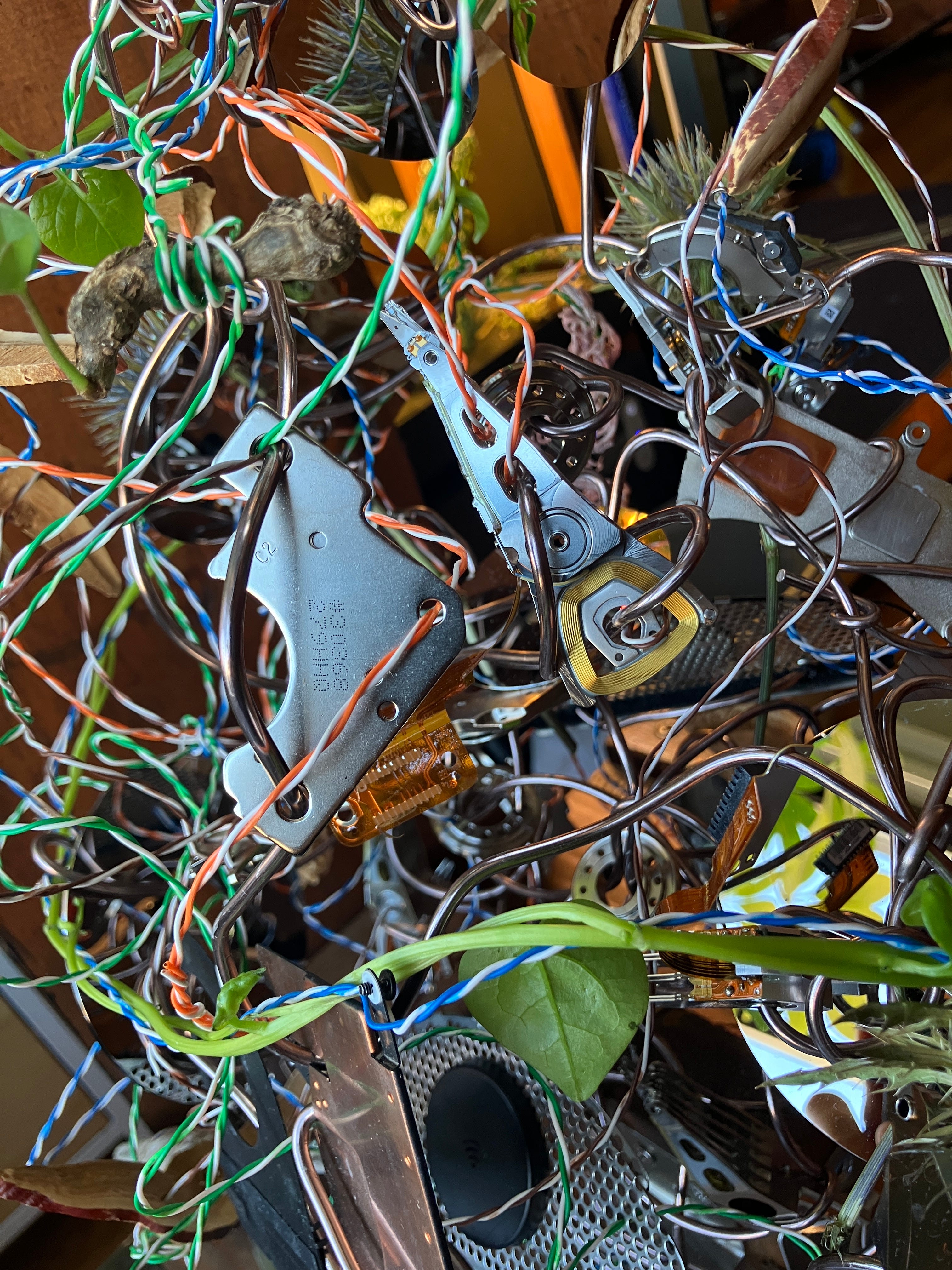
The last portion was inspired by a hydroponic housekeeping task. My Malabar spinach vine had been growing for six months straight, and was beginning to strain against the size of its home. After a point, the root structure becomes so large as to take up every bit of available space, leaving no room for water to move, and the plant’s own growth begins to starve it — and any plants downstream — of nutrients.
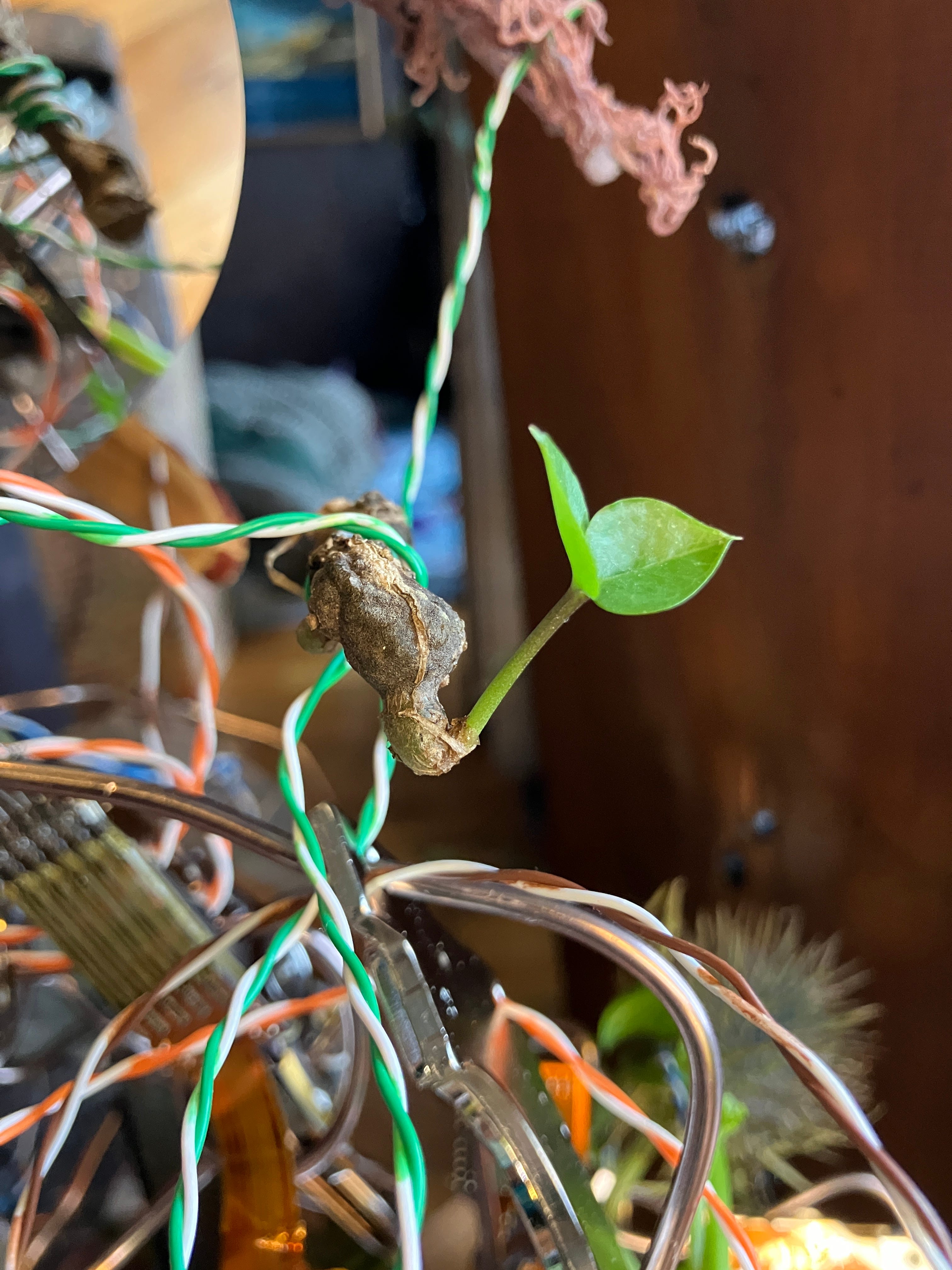
So, I devised a temporary vase from a tincture dropper, and placed a section of living vine inside the piece. I knew it would only live about a week, but the living structure would dry to become part of the piece.
There was a tiny plant, whom I named Kevin, set aside in a jar. Kevin had a bulbous root and only two leaves for over a year. No matter what I did, Kevin stayed the same. So, I added Kevin to the piece. Figured he wouldn’t mind. I’d take him back out later.
Lastly, I constructed a frame to contain and transport the piece out of scrap lumber, with a hefty wooden boat handle on top for carrying. The frame unfolds to its sides for installation.
Now… Was this all worth doing? Was what I’d built needed in the world?
All I can say is that the creation made me think about much I otherwise wouldn’t have. I will never get paid for the time it took in cash. But what I got in return for the effort was priceless.
I remembered, once more, how cool it is to not know what you’re building, and to see it happen in front of your eyes as one idea leads to the next.
There is something in that process that reminds me our future is never what we think it will be. Because, for all of us, this same process is unfolding all the time. Each decision leads to the next, and there is no brain among us who can foresee it all.
Where would be the fun in that?
So, yes.
If for no other reason than my own catharsis, this weird thing was worth building.
I wrote an “art statement” to go with the piece, which was nice to think about as well:
The “away” in throwing away is a lie.
There is no such magical place.
When we discard something poisonous or sharp, something difficult or impossible to digest, someone, something — or generations of them — have to live with it around and inside them. And it changes how they move, how they grow.
So when we find daggers in our own food, this is where they come from.
When we throw daggers, bullets, missiles, punches—
They never hit what we’re aiming for.