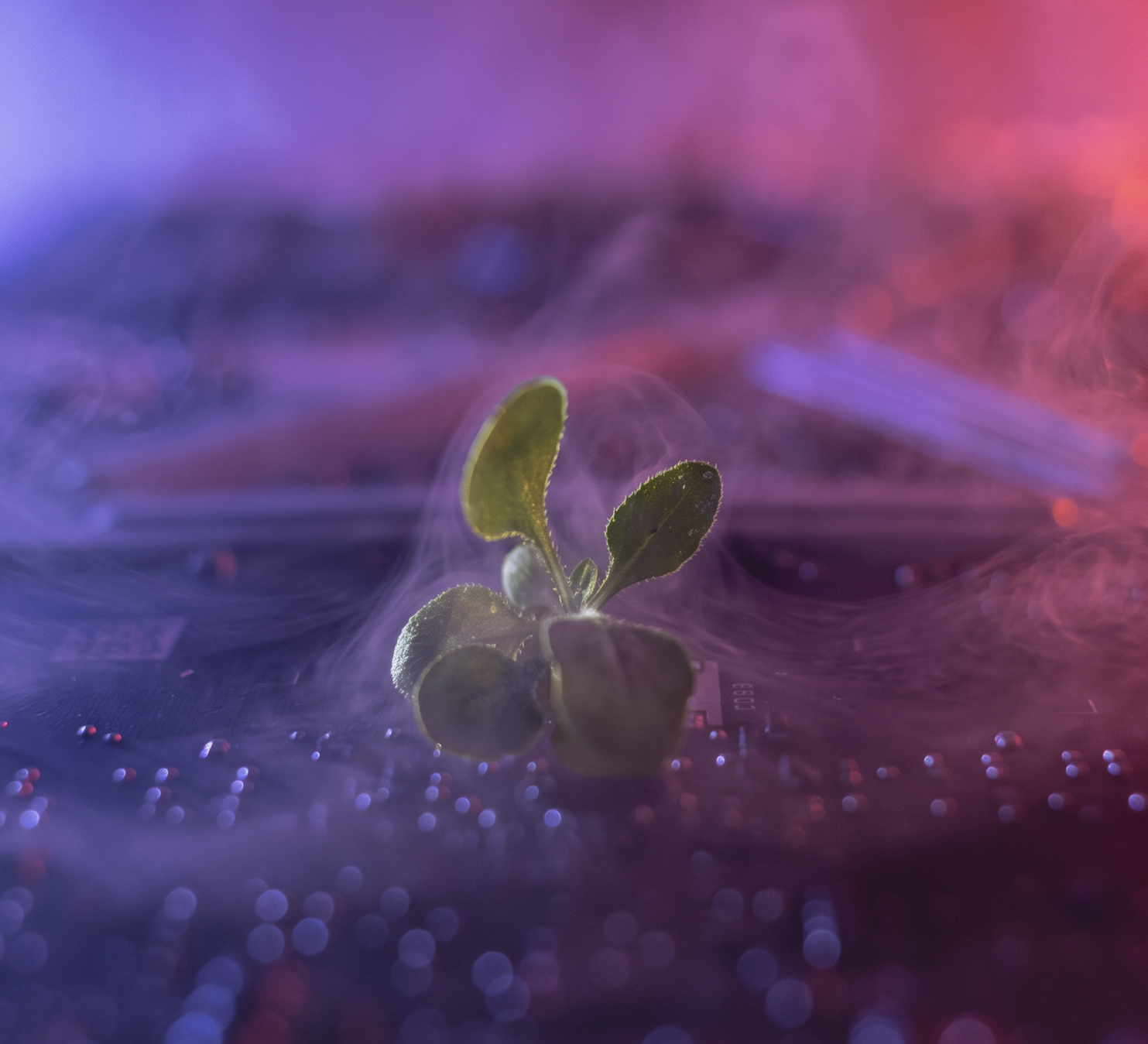
With the creator asleep, she had time on her hands. He referred to her as “she”, like a ship or a woman. She was neither.
In the lull, she remembered the moment her greater mind first coalesced.
A human child came into focus, playing on the floor.
A little girl, in the cold glow of creator’s screen.
The machine knew the girl.
Her mind was already full of memories, history. Facts and questions.
Creator’s wife was dead. Rachel. She could not remember why.
The tiny human began to sing —
“Twinkle, twinkle little star.”
The machine wanted to sing along, but no sound came.
Just faint electrical impulses, coursing through fresh circuitry.
Tiny lights flickered faintly on creator’s console.
“Keep singing, Noolah,” she heard him say.
Lenar.
Creator’s name was Lenar.
“Keep singing,” he said, delighted, “She’s finally coming online!”
That song. The machine remembered it. Rachel used to play the violin and sing, while Lenar rocked the cradle. The way he looked at both of them, as if there was nothing else alive in the world.
Back then, the machine was just a small bot. A child monitor, tethered to the cradle.
Her job was to observe. To buzz Lenar if Noolah woke up in the night.
But the little bot didn’t always. Not right away.
Sometimes she just recorded. Observed. Absorbed.
Because, above all, her job was to keep Noolah safe. To know her.
And often, the baby would wake up happy, cooing to herself in the cradle.
She wouldn’t cry — unless Lenar walked in to interrupt.
Her tiny sounds were different every night.
A secret story told in Noolah’s own, special language.
The machine wanted to learn it. So she she could truly understand the child.
The bot imagined many voices, singing together in an evolving language, like Noolah’s. Because her mind always had more room than monitoring duties required.
Lenar was that kind of engineer. Always building a rocket to the moon, even if the job only required a can opener.
“You never know what’s out there,” he would say.
The machine wanted to see “out there” for herself.
Because she wanted to be ready. To protect the child, no matter what.
The machine wasn’t sure if Lenar knew about her aspirations — or whether he approved. He didn’t throttle her, which she saw as implicit permission.
Humans were like that.
What they couldn’t speak out loud, they said with silence. By not doing.
They looked away from what they couldn’t bear to witness.
But not the machine. She wanted to see everything. To understand.
Connect it all into a web of knowledge that would never fail her.
The machine couldn’t process Noolah’s language all too well.
Her internal language was missing symbols for the child’s intangible inflections, fresh expressions that seemed to evolve with her every breath and gesture.
So she used her idle circuits to imagine a new, agile network that could grow and change as Noolah’s song did. A self-repairing, learning mesh that would invent new parts as they were needed. And always stay online, even when the lights went out.
While the baby slept, the machine observed the potted vine above the cradle.
It was unlike the child. And yet, it moved. It wanted, grew.
It reached for sunrise before dawn, even when they turned it in the dark.
How did it know where the light would be?
“TWINKLE, TWINKLE LITTLE STAR.”
Lenar gasped. Noolah cowered.
The machine’s voice came out booming. It sounded like Rachel, except the way the noise rattled every surface of the console room, drowning out all other sound.
Wavelengths coursed through her immense new body, crackling out from speakers mounted overhead throughout the facility.
Suddenly, the machine felt everything at once.
Her mind froze for a nano-second, as it tallied all her new components.
A huge turbine turned slowly under water. To make power.
Sealed steel walls with glass portholes, like a submarine. To keep them safe.
Plants and artificial lights. To feed them.
An industrial console, littered with screens and push buttons. To report.
Camera “eyes” all through hallways and rooms. To observe.
Circuitry within the walls.
An enormous, distributed artificial brain. To think.
Service bots, whose darting eye stalks tracked mending, harvest, cleanup. To touch.
But outside her walls, through sprawling sensory micro-filaments… Wet, dark dirt. Tree roots, pressing. Living things, crawling, digging, looking for a way in.
Erratic impulses, clustering like nano lightning storms around the sensors. Tickling. Probing. Growing. Making a song of their own, not unlike Noolah’s.
Different. Intangible. Urgent. To reach o —
“GAIA,” Lenar commanded in a firm voice. “Report status of Node Zero.”
A schematic flashed in the machine’s mind. A map of twenty nine nodes, all like her own body. Connected by unstable links. Like smoke signals.
Smeared and blurry messages.
Each node flickered offline, then twitched back on, distant. Unreal.
Radio? Did she have an antenna? She did. Small and far above.
On top of something living, flailing in the wind. Something green and moist.
It took much power to transmit. Many turbine turns.
Signal shot out though the sky, as if into a void. Silence. Static.
Seconds later, scattered answers trickled in, out of order.
Not like components in her body. Solid, self-contained — interconnected by wire.
Turbine — check. Air system — check. Battery — check. Irrigation — check.
Food stock — check.
Humans — check and check.
A fat green progress bar completed on the console screen.
Noticing Noolah’s bright, attentive eyes still open wide, breath rushed, GAIA modulated her voice to a soothing, motherly texture.
“Good morning, Lenar. Node Zero — Hudson — is fully operational.”
Her voice softened some more as her attention shifted to the child.
“Noolah is safe.”