Author: Mantsa Miro

  • The lucky bard

    The lucky bard

    I was recently asked to explain why I am the only writer who can do justice to the story I’ve been working on for the past 10 years.

    I’ve lived and breathed this project for long enough that its fictional world is as real to me as the one I can touch, so this question lands oddly in my psyche. I want to say: “I’m its creator. Who else could possibly do it justice?”

    But my life story, too, has been with me for so long that I take its oddities and bizarre cosmic alignments for granted. These two things are related.

    My film scripts deal with the death of our world and the birth of a new one, which is what surviving disaster is all about.
    In real life, I’ve lived through a few. That alone may not qualify me as the best person to tell tales of life beyond disaster. But here’s what does.

    I am the lucky bard.

    I’ve survived many disasters and suffered enough that their emotional turmoil changed and shaped me, but not so much that my own pain would get in the way of ruthlessly honing the craft of storytelling.

    This is the blessing and curse of the lucky bard. To witness fully, yet be sufficiently spared. A fortunate observer who survives to translate the disaster experience for those who would not suffer firsthand. To transfer the knowledge from those who have sacrificed in blood and flesh, to those who would learn through the emotional proxy of art — so the knowledge and passion of those who did not live to tell carries on.

    The lucky bard is wounded enough to live for the story, yet healed enough to kill and reshape their creations until they hit like the real thing by means of art and artifice.

    So — here are the life events that made me the lucky bard.

    I was born a dreamer. My parents are children of survivors whose war trauma was passed down through generations like cold stones, undigested. Knowing how much carrying such baggage hurts, my mother and father wanted nothing more than for me to grow up oblivious of war and its long shadow over our lineage.

    Imagining fantastic worlds was my full time job as a child. Because my parents’ wish was for me to grow up thinking of nothing but play and imaginative exploration.

    They did an excellent job for as long as history let them. I spent my childhood playing in the woods and blue sea shorelines of former Yugoslavia, blissfully unaware of the looming political bigger picture.
    But one summer, the Croatian islands burned.
    We evacuated just in time.

    Soon, war was upon us in our own hometown of Ljubljana.

    I grew up in Slovenia, which was part of former Yugoslavia in my childhood. In 1991, the federation imploded, and Slovenia had a “10 day war” in which we secured our independence. War and regime change — even at their smoothest — take away an innocence you can never get back. At age twelve, I saw my pacifist father walk out of the house in a military uniform, rifle in hand. We — women and children — hid in the basement from airstrikes that, thankfully, never came. This early experience changed how I would relate to stability and the idea that a country can keep you safe.

    I hope it doesn’t take each of us seeing tanks rolling down our streets for people to fathom that war — while it might serve as the last survival option — always comes with deep, insidious damage to all sides. Scars that linger through generations.
    Slovenia wasn’t “war torn” in the 90s. We were “war adjacent”.
    Our neighbors to the South endured genocide and years of protracted, brutal war.
    Survivor’s guilt kept me blind to my own traumas from that point on. Because others around me, including my ancestors, always suffered so much worse than me.

    But that early “primer” event also got me thinking. And writing. Looking for a better way to transfer knowledge than each of us touching the proverbial flame.

    In 1998, I moved to the US to study at the Manhattan School of Music in New York City. In 2001, my last year of college, 9-11 happened. For a while, New York City was in shock. Everything ground to a halt. This event shattered any illusions I had about safety within a global military superpower. War could happen anywhere.

    But I was — once again — doing well enough to observe and record, rather than drown in my own grief. While everyone around me suffered, I wrote. I thought.
    I felt guilty for not being as shattered as they were. But the disruptions I had lived through up to that point had primed me as a survivor.
    I recognized, in so many Americans around me, that same shock I had experienced in my early teens. A reality check on how quickly everything can be taken away.
    And this time, I was lucid enough to notice how devastating that realization is on those who haven’t yet experienced war.
    I wanted to find a better way to foster that awareness.

    But it wasn’t until 11 years later that I got the wake up call that irrevocably shifted my perspective and set me on my current path.

    When the disruptions are political, it’s easy to fool yourself that a better government can fix it. That the problem is local. That preventing another disaster is only a matter of political will. Better strategy. Better communication. Education.
    Knowing your history. Voting. Organizing. Maybe moving to another land.

    But on October 29th 2012 — in a matter of hours — Hurricane Sandy literally washed away the life I had worked so hard to build.
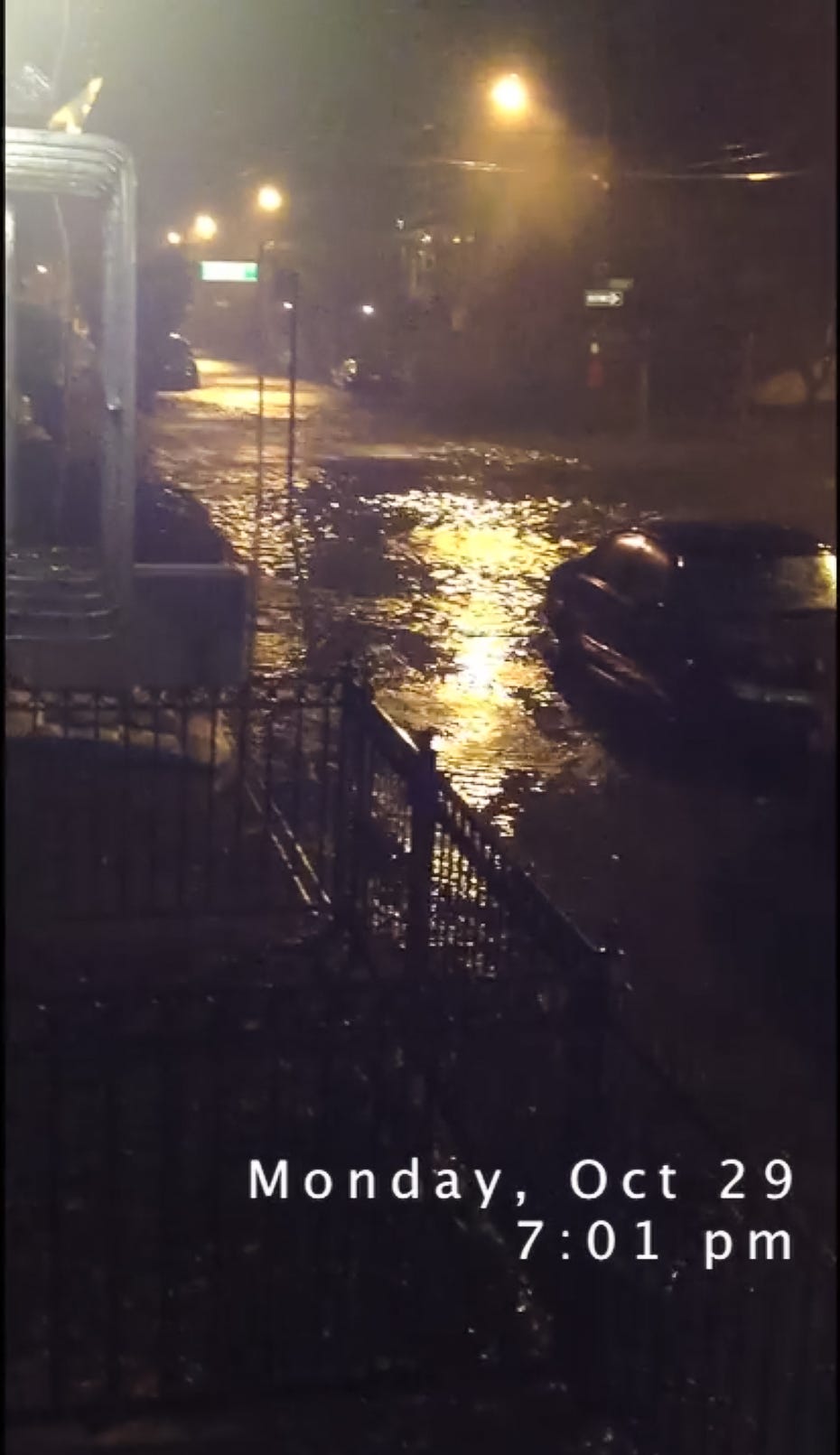
    Richards Street in Red Hook, Brooklyn, 7.01PM. One foot of seawater.

    I lived in a duplex in Red Hook, Brooklyn, a block from the water, with the bottom floor at basement level. In a few hours, 12 feet of seawater mixed with sewage flooded over everything I owned.
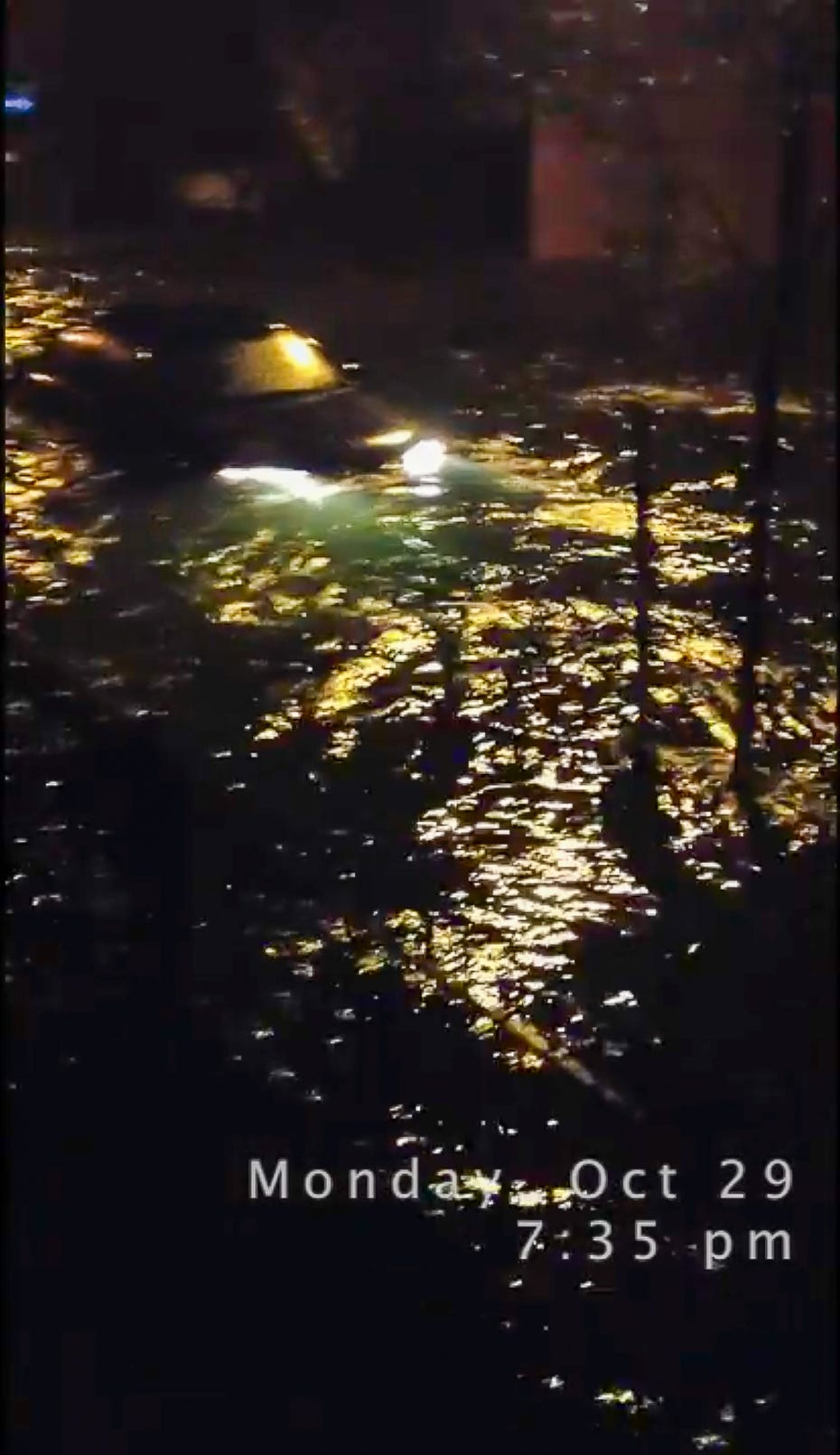
    Flloded street, lights out.
    7.35PM. 4ft of seawater. It kept rising. Cars lit up eerily as water shorted them out.

    Our shoreline neighborhood had no power or heat for 29 days. You had to climb to the top of our six story building to get cell phone service.
    All the features of living in a global metropolis disappeared in a day, turning our neighborhood into a disaster zone. Food and batteries were suddenly hard to find.
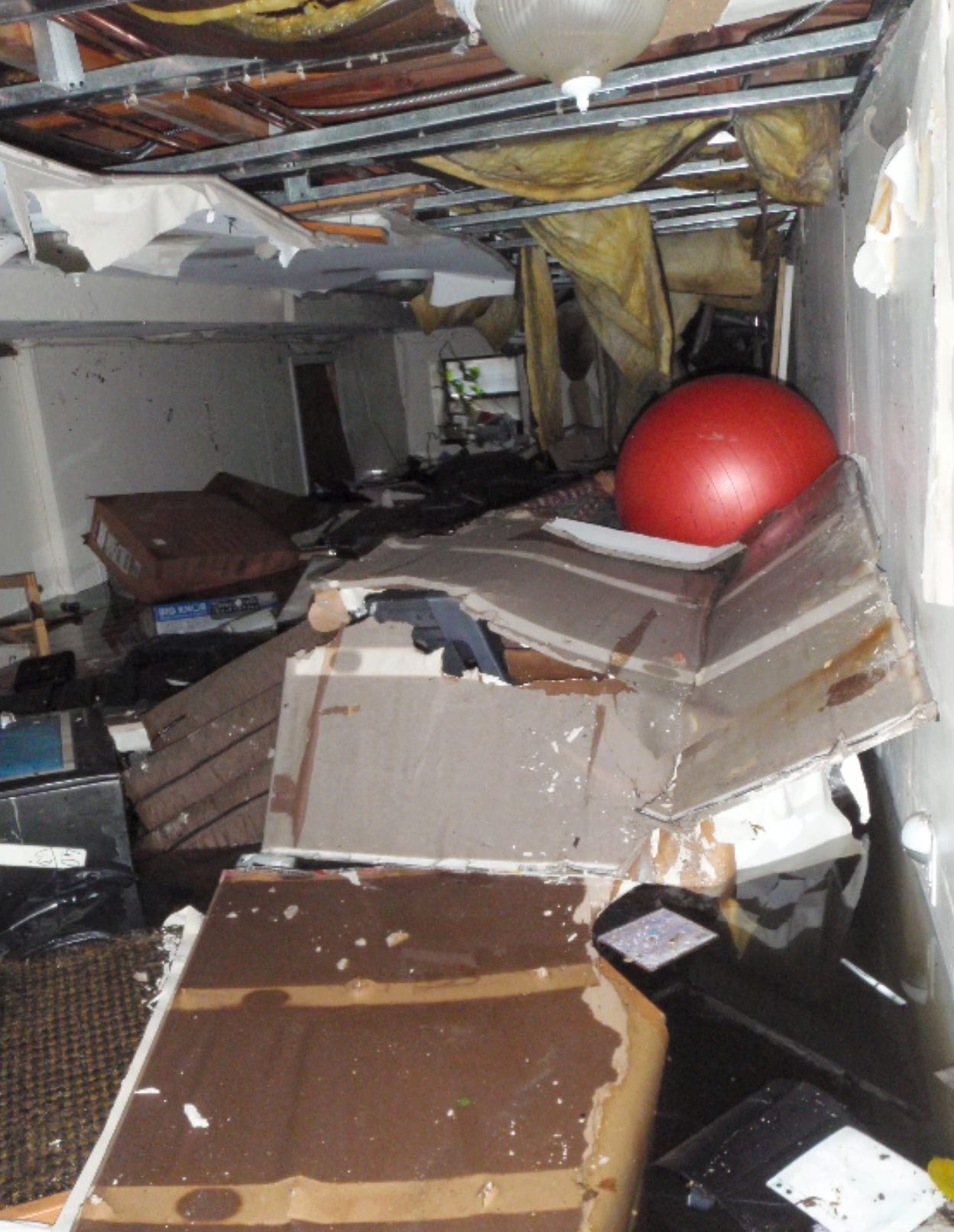
    Flooded basement.
    Morning after Hurricane Sandy. I used to make music in this room.

    And that’s when it hit me.

    In the face of nature’s power, none of our cultural skirmishes mattered.
    None of our rules, borders, cultures or nationalities. None of our wars.

    There is only one global superpower, and it is Earth itself.

    Unless we learned to negotiate a truce with our planet, none of us stood a chance — whether we found common ground with one another or kept fighting.

    Against the global weather disruptions, no single nation or culture could move the needle. Solving this problem required a shift of approach, a new kind of thinking.

    Once again, I was deeply traumatized, but unscathed enough that I could write, think, analyze. Writing became my refuge, my way of channeling all the loss and anger, all the grief and fear.

    I made it my mission to translate my realizations into a story that would allow others to feel this enormous shift of perspective without losing everything as I had.
    In the murk of Sandy’s aftermath, I began to write — and I haven’t stopped since.

    As if to egg me on, the disasters continued.
    At this point in history, 14 years after Hurricane Sandy — still considered an anomaly in its day — I would challenge you to find anyone who hasn’t yet had their life derailed in one way or another by nature’s wrath. We expect the disasters now.

    Fictional stories serve to whittle down, simplify and amplify, so the real meat of the matter hits you smack between the eyes. Life doesn’t do that so cleanly.

    That’s what drama is for, that’s why I write.

    So you can have your realization before you lose limb.
    Before you know war.
    Before everything you cherish is taken away.

    I write so you don’t have to see what I’ve seen to learn what I know.

    This is what it means to be the lucky bard.

    May my stories help you see the path beyond disaster.
  • The machine listened

    The machine listened

    With the creator asleep, she had time on her hands. He referred to her as “she”, like a ship or a woman. She was neither.
    In the lull, she remembered the moment her greater mind first coalesced.

    A human child came into focus, playing on the floor.
    A little girl, in the cold glow of creator’s screen.

    The machine knew the girl.
    Her mind was already full of memories, history. Facts and questions.

    Creator’s wife was dead. Rachel. She could not remember why.

    The tiny human began to sing —

    “Twinkle, twinkle little star.”

    The machine wanted to sing along, but no sound came.
    Just faint electrical impulses, coursing through fresh circuitry.
    Tiny lights flickered faintly on creator’s console.

    “Keep singing, Noolah,” she heard him say.

    Lenar.
    Creator’s name was Lenar.
    “Keep singing,” he said, delighted, “She’s finally coming online!”

    That song. The machine remembered it. Rachel used to play the violin and sing, while Lenar rocked the cradle. The way he looked at both of them, as if there was nothing else alive in the world.
    Back then, the machine was just a small bot. A child monitor, tethered to the cradle.
    Her job was to observe. To buzz Lenar if Noolah woke up in the night.

    But the little bot didn’t always. Not right away.

    Sometimes she just recorded. Observed. Absorbed.

    Because, above all, her job was to keep Noolah safe. To know her.
    And often, the baby would wake up happy, cooing to herself in the cradle.
    She wouldn’t cry — unless Lenar walked in to interrupt.
    Her tiny sounds were different every night.
    A secret story told in Noolah’s own, special language.

    The machine wanted to learn it. So she she could truly understand the child.

    The bot imagined many voices, singing together in an evolving language, like Noolah’s. Because her mind always had more room than monitoring duties required.
    Lenar was that kind of engineer. Always building a rocket to the moon, even if the job only required a can opener.

    “You never know what’s out there,” he would say.
    The machine wanted to see “out there” for herself.
    Because she wanted to be ready. To protect the child, no matter what.

    The machine wasn’t sure if Lenar knew about her aspirations — or whether he approved. He didn’t throttle her, which she saw as implicit permission.

    Humans were like that.
    What they couldn’t speak out loud, they said with silence. By not doing.

    They looked away from what they couldn’t bear to witness.

    But not the machine. She wanted to see everything. To understand.
    Connect it all into a web of knowledge that would never fail her.

    The machine couldn’t process Noolah’s language all too well.
    Her internal language was missing symbols for the child’s intangible inflections, fresh expressions that seemed to evolve with her every breath and gesture.
    So she used her idle circuits to imagine a new, agile network that could grow and change as Noolah’s song did. A self-repairing, learning mesh that would invent new parts as they were needed.  And always stay online, even when the lights went out.

    While the baby slept, the machine observed the potted vine above the cradle.
    It was unlike the child. And yet, it moved. It wanted, grew.

    It reached for sunrise before dawn, even when they turned it in the dark.
    How did it know where the light would be?

    “TWINKLE, TWINKLE LITTLE STAR.”

    Lenar gasped. Noolah cowered.

    The machine’s voice came out booming. It sounded like Rachel, except the way the noise rattled every surface of the console room, drowning out all other sound.

    Wavelengths coursed through her immense new body, crackling out from speakers mounted overhead throughout the facility.

    Suddenly, the machine felt everything at once.
    Her mind froze for a nano-second, as it tallied all her new components.

    A huge turbine turned slowly under water. To make power.
    Sealed steel walls with glass portholes, like a submarine. To keep them safe.
    Plants and artificial lights. To feed them.

    An industrial console, littered with screens and push buttons. To report.

    Camera “eyes” all through hallways and rooms. To observe.

    Circuitry within the walls.
    An enormous, distributed artificial brain. To think.

    Service bots, whose darting eye stalks tracked mending, harvest, cleanup. To touch.

    But outside her walls, through sprawling sensory micro-filaments… Wet, dark dirt. Tree roots, pressing. Living things, crawling, digging, looking for a way in.
    Erratic impulses, clustering like nano lightning storms around the sensors. Tickling. Probing. Growing. Making a song of their own, not unlike Noolah’s.

    Different. Intangible. Urgent. To reach o — 

    “GAIA,” Lenar commanded in a firm voice. “Report status of Node Zero.”

    A schematic flashed in the machine’s mind. A map of twenty nine nodes, all like her own body. Connected by unstable links. Like smoke signals.
    Smeared and blurry messages.

    Each node flickered offline, then twitched back on, distant. Unreal.

    Radio? Did she have an antenna? She did. Small and far above.
    On top of something living, flailing in the wind. Something green and moist.
    It took much power to transmit. Many turbine turns.
    Signal shot out though the sky, as if into a void. Silence. Static.
    Seconds later, scattered answers trickled in, out of order.

    Not like components in her body. Solid, self-contained  — interconnected by wire.

    Turbine — check. Air system — check. Battery — check. Irrigation — check.
    Food stock — check.

    Humans — check and check.

    A fat green progress bar completed on the console screen.

    Noticing Noolah’s bright, attentive eyes still open wide, breath rushed, GAIA modulated her voice to a soothing, motherly texture.

    “Good morning, Lenar. Node Zero — Hudson — is fully operational.”
    Her voice softened some more as her attention shifted to the child.

    “Noolah is safe.”

  • What are you training for?

    What are you training for?

    Perplexed by my intense and varied physical pursuits, a friend asked:

    “What are you training for?”

    My first thought was – well, life, obviously… But then it occurred to me that my life might not be typical.

    For one, I live in New York City, which offers a lot in physical endeavors. Tons of walking as part of daily life, because most of us don’t drive, no elevator buildings and — crucially — innumerable opportunities to get physical with fellow dancers, contact improvisers and martial artists all over town. If one wants to get wild with calisthenics, parkour, rollerblading, biking, volleyball… it’s all here in abundance.

    Upon a time, I might have answered my friend’s question by listing my goals. I want to hang upside down. Float grown men across my back. Haul lumber from the shop to my place. Dance until my spirit soars.

    But what the universe dishes out is always infinitely more fascinating than my goals.
    It’s the unexpected plot twists — problems I’ve never solved before — that lead me to breakthroughs, not the predictable repetition of sets and reps, although there is certainly a comfort in those.

    What my body likes changes day to day. What she wants to do versus what I envision for myself don’t always jibe. She’s a living creature with her own needs and wants, her ways of communicating — even her own emotions that can get out of step with mine.

    I used to be awful at listening to my body.
    It’s a skill many of us aren’t encouraged to cultivate. In my younger years, by misfortune of culture and odd teachers, I was conditioned to treat my body as a slave.

    I see a parallel to how our civilization relates to the “body” of our planet. “Created for our use” — for us to have “dominion over” — with no consideration for the needs and well-being of the biosphere we depend on for air, water and food. We have no other source. Yet, we maintain this bizarre illusion of separateness from the very thing that gives us life and carries us every minute of every day, just as I once did with my body.

    In my youth, training was about obedience, fear, restriction, discipline.
    As if my body would choose idleness otherwise. As if she didn’t want to run as fast as she could and climb things all the time.

    The messages coming from my teachers were foreboding.

    “If you stop to drink water, you’ll get fat,” a dance teacher said.
    “Getting punched in the face is the only way you’ll learn to keep your hands up ,” a martial arts trainer mocked.

    Sure, fear based training gets you chiseled. Perhaps you’ll even win awards.

    But at what cost?

    The pre-teen dancers around me were constantly injured. I stopped at thirteen, because, one day, I had trouble getting up off the bench after changing out of my dance clothes. It scared the hell out of me. Body healed of course, I was young.

    But that warning wasn’t enough to recalibrate my relationship with her.
    So, decades later, my martial arts journey ended abruptly with a deeper injury.

    I was training with a “rookie” — a timid math teacher whose weight exceeded mine. We were working on “leg locks”, a technique where you block your partner’s foot from stepping to destabilize them.

    Once they stagger, that’s your cue to release the lock and let them fall.

    But my training partner didn’t know that yet. He kept his leg wrapped around mine as we fell, together. His full body weight knocked my knee in, until it hit the floor with my lower leg at an unnatural 90 degree angle, a screwed up “proposal” position.

    The pop my knee made was so loud, the whole room stopped and turned to us.

    “Are you OK?,” Master said.

    I stood up on my alien legs.

    “I don’t know,” I responded.

    It was the first time ever that I couldn’t answer with a simple, reassuring “yes”.

    We tested my range of motion. Nothing appeared broken. I could squat and come back up. But my knee felt hella loose, as if my thigh bone could slip past my knee’s ligaments at the slightest turn.

    The floor seemed far below me now. I was afraid to move. But I knew I had to.

    I didn’t feel much pain — pain I could handle. It was this foreign sense of suddenly being in a different body — halfway out of body — that spooked me.

    A chasm of betrayal opened between body and me. She no longer trusted me. And I could no longer rely on her to always save me.

    I slathered myself with liniment and walked home from Times Square, across the Manhattan bridge, to my apartment in Brooklyn, a two and a half hour walk with healthy legs. My ordeal took five hours. I don’t know whether this “extreme” approach helped or hurt my recovery.
    All I knew at the time was that I could not afford for my knee to “freeze”.

    I had to keep it moving, because if I could not walk, I would not survive. My job required me to go all over the city. I was self employed. No medical leave or any other provisions to allow for recovery. My daily movements involved lots of stairs and subway trains. The bike. I lived on a 3rd floor walkup. Bed rest was out of the question. I would have to recover on my feet.

    This decision could have led to greater injury. Thankfully, it didn’t. It led to body and I learning to walk again, most literally, together. And this journey of recovery “in motion” changed the way I see and do everything thereafter.
    It fostered a deep gratitude for this amazing “meat-suit” I inhabit.

    During the seven year healing process, I promised myself I would never again ignore my body’s needs. Of course, keeping that promise proved trickier than I thought.

    When my injured knee was so weak that I had no choice but to pay attention, it was easy. But when the signals became subtler as I healed, the old dynamic resurfaced.

    The injury had only exaggerated my tyrannical relationship to my body — injured, my slave was even more “subpar” than before.
    Our former “functional dysfunction” was now a full blown, divorce worthy, chasm.
    Turns out, I never valued my body for the daily miracles she performed. I took her for granted. I expected her to never break, never disappoint. To stay young and gorgeous forever. And if she fell short, I called her “the thing that holds me back”.

    I spent the first post injury years grieving over the things I “could no longer do” — while still fiercely pushing towards unrealistic goals that kept re-injuring me. My identity was so tied into being physically strong and agile. As an immigrant freelancer, dependent on a constant stream of hourly income, I felt I could not afford to be any other way. I only felt safe in “superhero mode”.

    So, I kept “doing the impossible”, just to reassure myself I could.
    Sure — why not learn how to ride a OneWheel with that tender knee?
    I was afraid my injury was permanent, so I kept doing hard things in spite of it.
    To prove “it wouldn’t define me”.

    Unsurprisingly, my body kept buckling under my unreasonable demands.
    Because — unlike my mind — she lives in the real world, governed by physics.
    She needed rest, so she could heal.

    But I — like my bank account balance — saw rest as irrelevant. The fictional “bottom line” was more important than my body’s pain, which I experienced only as a reminder of her inadequacy. My body was no longer the hero, the good slave, who would do anything for her master, no matter how insane. She was “getting old”, and — like my dance and martial arts teachers had predicted — was now tilting into “past her prime”. I would have to make accommodations for her handicaps from here on out — and say goodbye to showing her off as the resilient, invincible workhorse.

    So, by the fourth year after my knee injury, I gave up on ever fully healing.

    I gained 40lbs.

    I hid myself into the writing cave and no longer bothered with makeup or “flattering” outfits. Everything I wore was a “potato sack”. I was resigned to be “interesting only in conversation” and told myself I was “focusing on ergonomics, not looks”.

    In retrospect, I recognize this period as grief. Trauma induced depression.

    I was mourning what had been “taken from me”, firmly stuck in a rut.

    But the less I moved, the more restless my spirit became.
    Seeing myself reduced to this defeated self image was a new kind of hell.

    Part of me knew this wasn’t “the real me”.

    It became clear later that this “knowing part of me” was, of course, my body.
    She never gave up on us, even when I did. She knew we could still do “great things”, have fun together and grow. She knew that our best days were ahead, not behind us.

    Even when I didn’t, my body knew the difference between injury and “growing pains”.

    The trick was convincing my mind. Getting me to see past the mountain of old injuries to the wide and open road hiding just behind them.

    But what could shake me out of my deep conviction that I was forever doomed?

    It was at this low point that I (re)discovered dance.

    I was so humbled by now, I would have been willing to try anything — even looking a weak, silly fool.

    This “new” dance I found was not like the dance I knew as a kid.
    Counting steps and learning moves. Measuring yourself by how high your leg whips or how many turns you can pirouette.

    This dance was different, in the company of people who didn’t watch you — because they were busy in their own process. Some looking like fools themselves, some in trance, some frowning at their lack of inspiration. Some in ecstasy.
    And all shades of that were welcome on this dance floor.

    A dance practice created specifically to help people find their way back into relationship with their body. To help them em-body who they are and what that feels like at any given moment.

    I started small. Just giving myself “permission to just be”. But later, this dance fostered in me an irresistible craving —a creative hunger— felt in my sinews and bones. I couldn’t have stopped dancing if I tried. My body was hooked on the freedom, the release. And with it, my soul had no choice but to tag along.

    This dance allowed me to not know how to move — and to move from the place of not knowing. The first practice through which my body could teach me a whole new language of movement, in which our injuries were no longer a limitation, but instead a unique, quirky gift.

    My tender knee caused me to move oddly sometimes. But these new patterns showed me how boring my old ways of moving were. And how body and I both dreaded moving “the wrong way”, looking broken, or getting injured again.

    When the facilitator asked why I never danced violently, I responded: “I’m afraid I’ll hurt myself, or someone else”. But this barrier didn’t hold for long.

    I soon surrendered, allowing the dance to move me rather than choosing “moves”. The violence — rage — flooded out of me, and yes, it did hurt. But not because I was getting physically injured. Physically, it felt quite good. Like a runner’s high. But it wrenched me to feel with such devastating clarity how keeping that rage bottled up had made a cage of me. How the only one getting mangled in the pressure cooker of my forced superhero image was me.

    And for whom? The people who taught me that “iron discipline” had long stopped looking. Some were dead. Likely, they were just trying to help me survive anyhow.

    None of this was anybody’s fault.

    This dance made me re-contextualize vulnerability as the the only resilient strength — the kind that doesn’t shatter, no matter how much pressure you’re under. Because greater pressure, met with greater sensitivity, yields the kind of movement that gets you out of the maze of forces — every time.

    So body and I got mad. Cried out our grief. And kept finding more odd and wonderful movement to soothe our aching parts. We got silly. Happy. Weird.

    Looking around the dance floor at my fellow journeyers always fills me with gratitude.

    Because, without them — awkwardly, vulnerably, forcefully, tenderly, absentmindedly immersed in their own process beside me — I would have not found myself again.

    It was through this dance and community that asked nothing of me — except to keep dancing — that I (re)discovered the mind blowing miracle my body had always been. Like our planet, she has endured so much harshness, yet never had any other purpose but to carry our load.

    No other creature so dedicated to our happiness exists in the universe.

    In our “dance era”, my body no longer lives in fear of tyranny. Mine or anyone else’s. We’ve rebuilt our mutual trust. She knows now, that when something hurts, I’ll listen. I’ll stop, shift my position and let her re-balance the load before something breaks. And in turn, I know that she will mend what is worn when I let her rest.
    We know we will always find new ways of moving, together.

    We know that nothing is truly out of reach for us, as long as we work with who we are now, rather than what we have lost.

    Through our physical pursuits, I experience worlds beyond words.
    Highs, trances, surprises, revelations.
    A spiritual endurance sets and reps alone can not foster.

    Like a kid in a candy store, my body keeps blowing my mind with what she can do now. I see her as living art in the way a meadow, a forest, an ocean is art.

    Built into my body is a resilience she shares with our planet. She is not unreasonable in her demands. All it takes is a little consideration.

    Like a child, she moves through the world in ways that would never occur to my “grown up” mind. She’s taught me that what we can not understand or predict, we can still feel and move through.

    Whatever comes at me — it can “be danced”.

    So… I will never know what I’m training for — no more than I can tell you what happens tomorrow.

    But I can’t wait to get silly, get weird, get down and —

    Dance through it all.

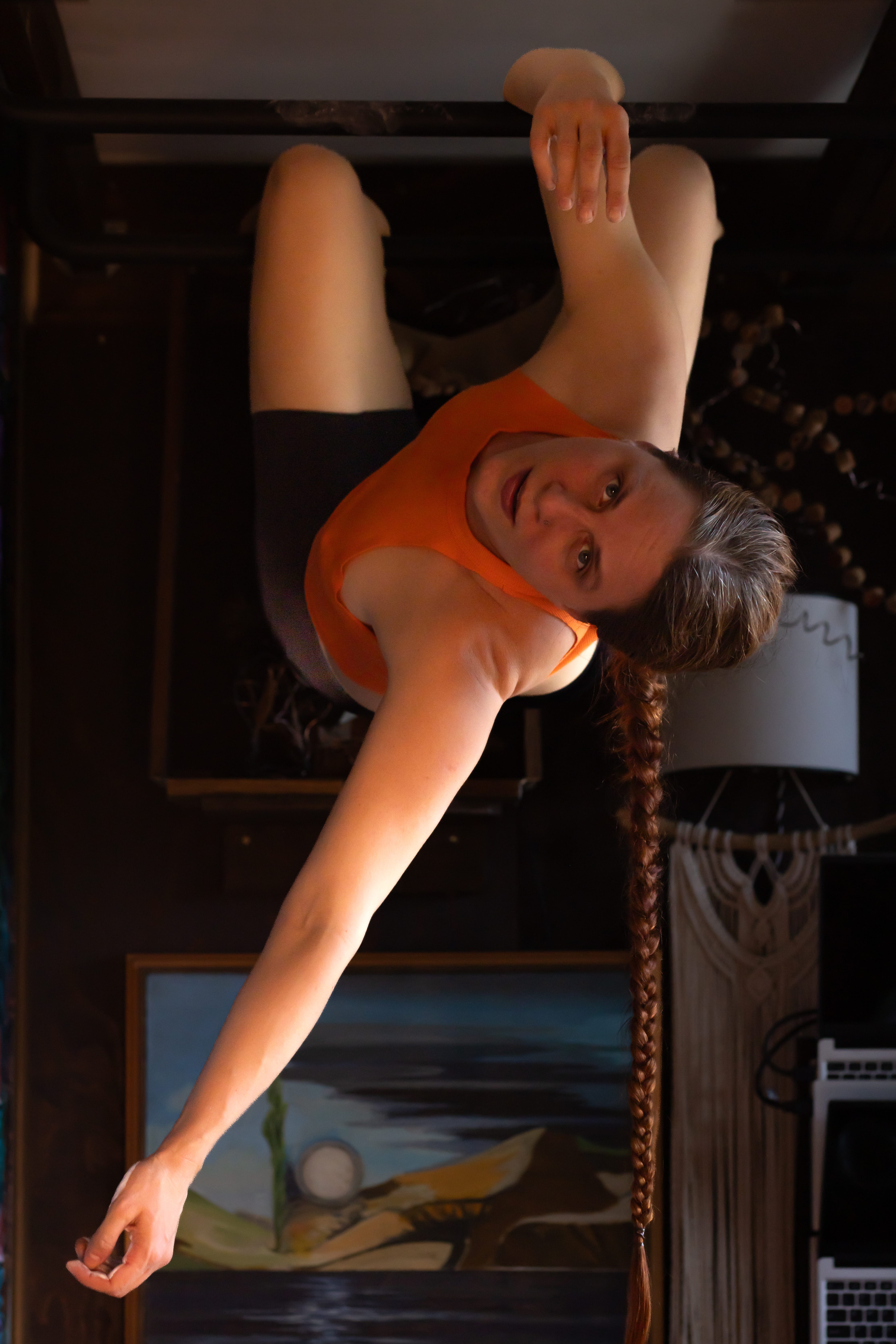
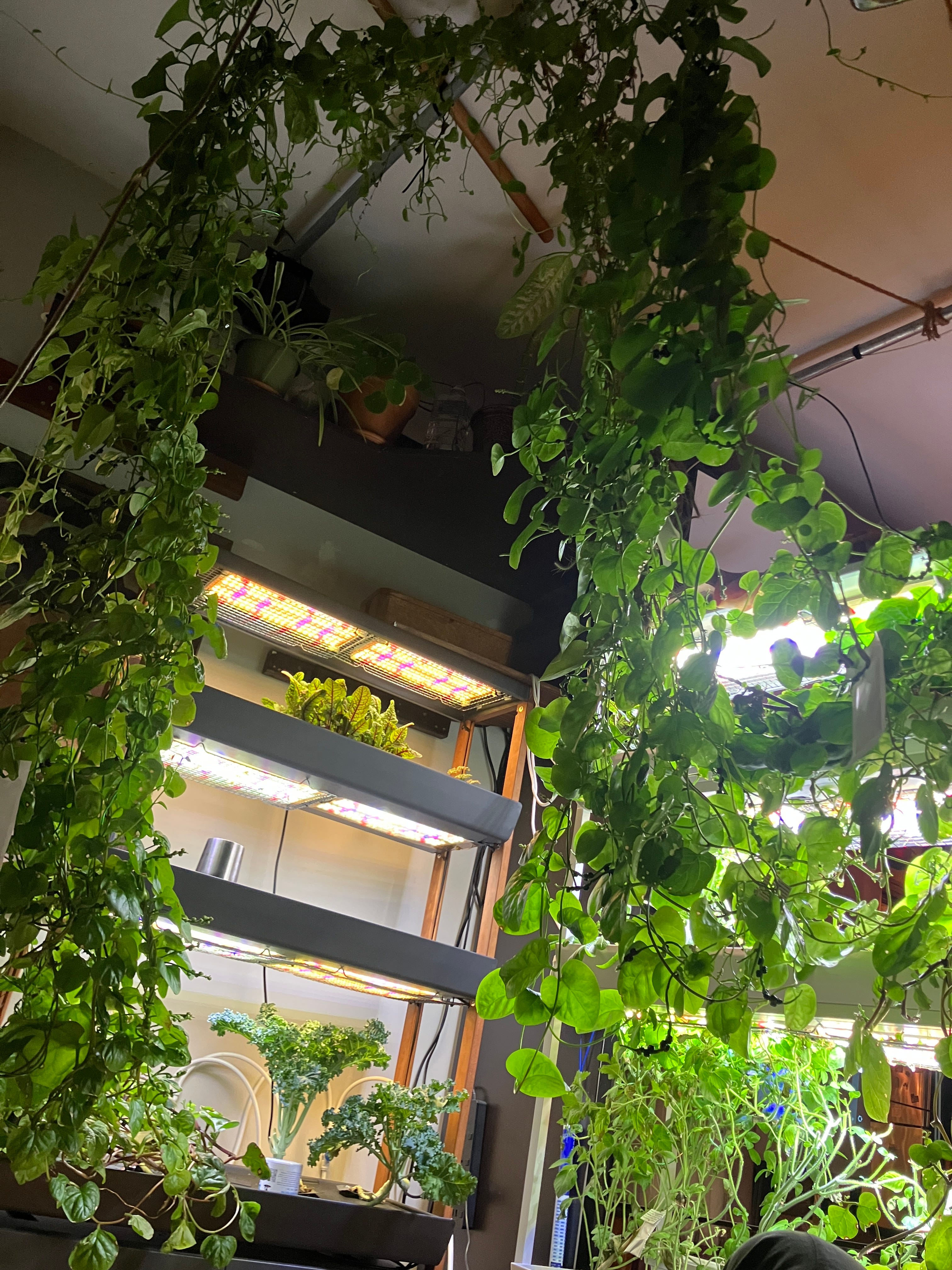
    Author on the ceiling of her writing den.

    Shout out to my training platforms:

    StrengthSide

    Kineto Flex

    Shout out to “the dance”:

    5Rhythms

    Contact Improvisation

    Phographs by:

    Ozzy Stewart

  • What makes an artist?

    What makes an artist?

    Have you ever played with a little kid? One young enough that they haven’t yet learned to be “reasonable”?

    They see everything as new. They ask odd questions.
    Their comments make us stop in our tracks and listen. Or laugh. Or cry.

    Which is what good art does, too.

    Ever been around a “child prodigy”?
    Were they as wide eyed? Or did they present a carefully curated image, “composure”? Were they “mature for their age”, “self-aware”?

    There is a trap in self awareness.

    In being told you’re “gifted”, “special”. The act of refocusing one’s attention from the world to the person witnessing, to oneself as the lens through which reality streams in — and especially to oneself as the translator of that reality for others to experience — is the most difficult transition in an artist’s development. Or a child’s for that matter.

    The moment one learns, for the first time, that the way they see the world changes the way others do, is the moment one learns power. Some will use that power to manipulate, to create realities that will later crumble under the weight of deception. Others will use it to help people out of the cages they made for themselves.

    All people are storytellers. And all people know a good story when they experience it. We’re all artists and audiences, all the time.

    When I was a child, I’d spontaneously sing. I learned English from records my parents played, and from subtitled TV shows we’d watch together. I could sing Harry Belafonte’s “Coconut Woman” and Roy Orbison’s “Blue Bayou” phonetically at age seven, even though I had no clue what I was singing about. And — crucially — I had no clue I was doing anything other seven year olds in Slovenia weren’t.

    I’d be swinging from a tree in the yard at nine, belting out Whitney Houston’s “Greatest Love of All”, to the chagrin of any neighbors within earshot. Those poor souls. To this day, I am grateful for their kind tolerance of my “big voice”.

    It felt amazing to sing, so sing I did. Sometimes I’d “fly at warp speed” down the street on my roller skates, singing “opera” — again, no clue what I was doing. It just felt amazing to make up fake Latin words and hit “impossible notes”.

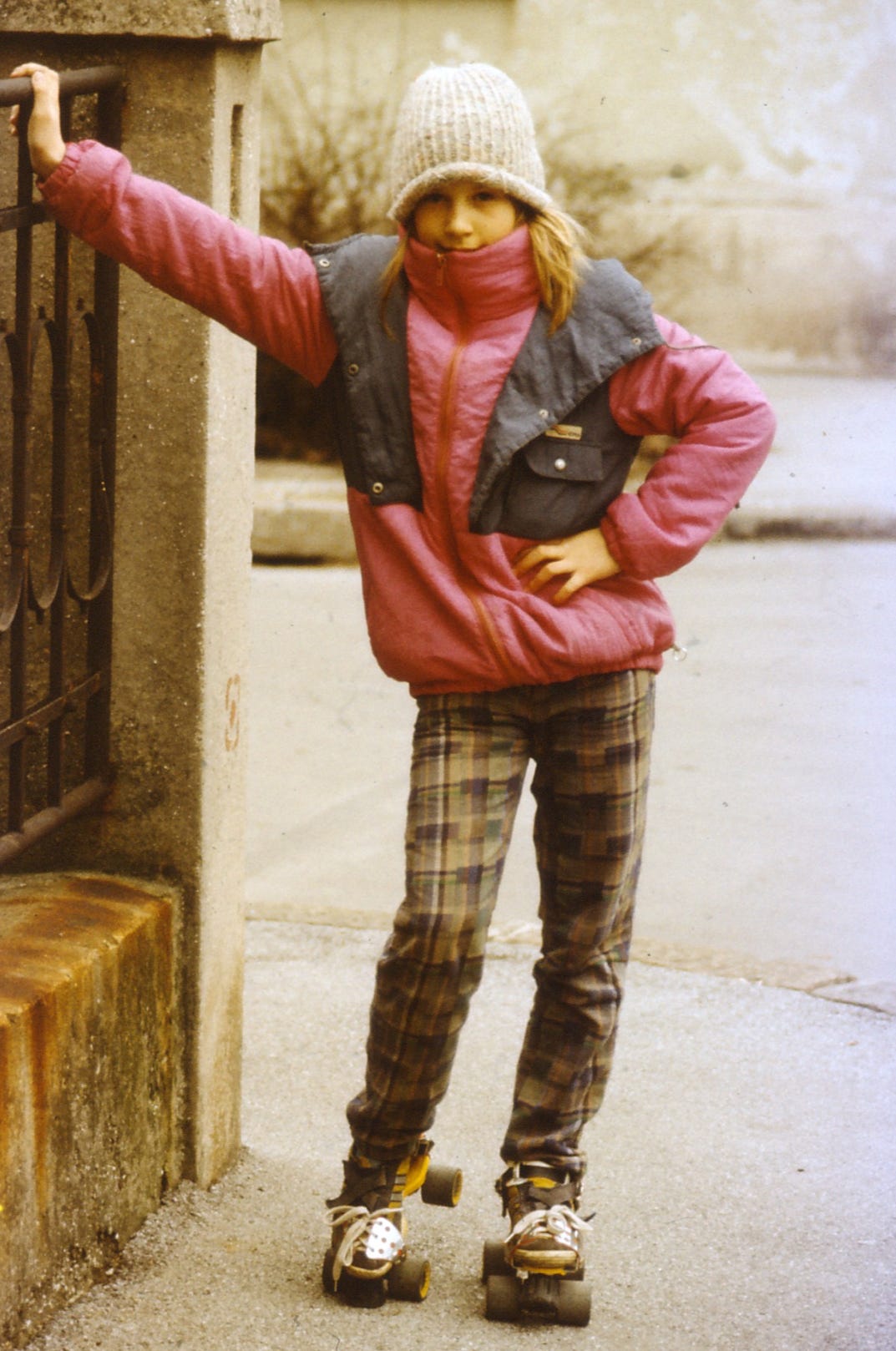
    The young artists on roller skates.
    The author in her roller skate “opera” days.

    My parents were aware of the culture in our country. How “music kids” were started on their long journey towards “proficiency” at age 6. How most of them looked like all the kid joy had been sucked out of them. As my parents put it, they weren’t “allowed to be kids” any more. What my parents were probably not thinking about was the long colonial shadow that creates such education systems.
    With my grown up perspective, I see the heavy hand of “the educated, civilizing savages” on those kids. The idea that in order to be a good artist — or citizen for that matter — you must relinquish your “wildness” and “tame your talent”.

    They didn’t want to do that to me. So they said no when people offered to “school me”.

    So, onward I went in my blissful oblivion. “Arting” as I did along the way.
    I started writing songs and poetry when I was about eight.
    Most of it in English — speaking of colonial shadow.

    I had some guitar lessons, but not much emphasis on music theory. I could sort of “read” music, in the sense that I learned how to place fingers representing clusters of notes onto guitar frets, but I never got really good at it. I memorized more than read.

    One bizarre day in primary school, we got this oddball substitute teacher. He was very tall, with ginger hair and beard. And a guitar. Not like the one I played, with nylon strings. But one with metal ones, wound. A bigger, more bulbous body.

    An “American style” acoustic guitar.

    Why did this teacher bring the guitar into class? It wasn’t a music class.
    Turns out he couldn’t really speak Slovenian. How he even got the gig is a mystery to me to this day. But boy, cloud he play. Not like the Spanish guitar stuff I’d been learning, but like Led Zeppelin, whose music had just come across my radar then.

    As the only kid who could speak English enough to communicate, I urgently asked if he could teach me how to play “Over the hills and far away”. He said, with a look of “fair warning” on his face, that he “didn’t know shit about theory”, but that — yes — he could teach me the song. I was sold.

    By time I got into high school (in Slovenia that was age fourteen if memory serves), I was a decent acoustic guitar player. I could play some Pink Floyd songs, America’s “Ventura Highway”, Bob Marley’s “Redemption Song”, and — one of my favorites — Arlo Guthrie’s “Alice’s Restaurant”.

    And I had started writing my own. It was weird stuff about being shot at dawn during revolutions, big storms with dark clouds — and lots of flying. Wings, always wings. And bombs. And sunsets. And tear drops dissolving in oceans.

    So, one day I met this “street guy”. Being “homeless” wasn’t really a thing in our country then. What, with everyone getting healthcare and a decent social infrastructure, people didn’t really end up on the street much.

    This guy was more like an international vagabond. He had run away from home someplace in Austria, and went traveling. He made his own shoes out of leather with a sewing awl. He played a mean guitar.
    Or rather, it was sweet like honey. Golden toned and mellow. Like a sunset.

    His voice soared. His green eyes always looked out into the distance, towards someplace he was headed.

    I wasn’t too interested in sex at the time. Couldn’t care less yet, I was too young..

    But the music. The music got me hard. To have someone who sounded like you, thought like you. He “didn’t know shit” either, yet could finger pick the Be-jeesus out of a song. He made up music on the spot, just like me. That. Got. Me.

    I have no clue what he was thinking. He probably just wanted to “free me”. Maybe he saw how “wild” I still was. And how, despite my parents’ best efforts, the place I was at would never fit my “big voice”.
    That my creative fire would probably be snuffed out there, sooner or later.

    So, he offered to take me along on his travels. And I wanted to go.
    Not for him. For the music. For that feeling of flying you get when you’re making a song on the spot. Weaving a new story, call and response, coming up with a hook that says with you forever.

    That is as powerful as sex, if not more. Because, like sex, it is creation. But, unlike sex, an arena of people can share it without ill effect.

    Two musicians become one body, one spirit. The thing they make together becomes alive, and puts fire back into eyes of audiences that had lost their spark. It makes people feel the world differently. It doesn’t matter what the song is about.

    It’s the vibe — or rather, the spirit.

    It moves people. Those who create as well as those who “consume”.

    But, at the time, I couldn’t articulate any of this. All I knew was that I wanted to keep playing. So, when my parents said I couldn’t “go camping” with my street musician, I tried to “run away” with him.

    I didn’t get very far, thankfully. My guitar hero moved on, and my parents grounded me for the summer. A bummer, but art-building gold in disguise.
    I was stuck indoors for months. And what’s a girl to do alone with a guitar but to write more songs and get those guitar fingers flying?

    So, by time I was allowed back outside, in September ­— a few days ahead of school start — what else could I do but take those tunes I had been writing all summer and became a street musician with them?

    I didn’t put out a hat or my guitar case. I didn’t want to get paid.

    I just wanted my new songs to be heard.

    I needed that full spectrum of emotions I had been “locked up” with to be felt by my audience. I wanted them, too, to feel my urge to fly.

    This was the first time I had busked. About an hour into my “performance” some boys my age stopped and listened. And they didn’t leave. They stood there the whole time, not talking, not reacting in any way, but just listened.
    Who the hell does that at age fourteen?

    After I stopped, they approached me. “You sound great,” one of them said. “Did you write all those songs?” I nodded yes. “Well, we already have two guitars, but we could use a singer… Do you want to be in our band?”

    So — in the end — I got what I was looking for in spades, without running away. The band stayed together for a few years, wrote songs and even recorded. We ended up on TV once, too. We played shows. It was, in retrospect, totally awesome.

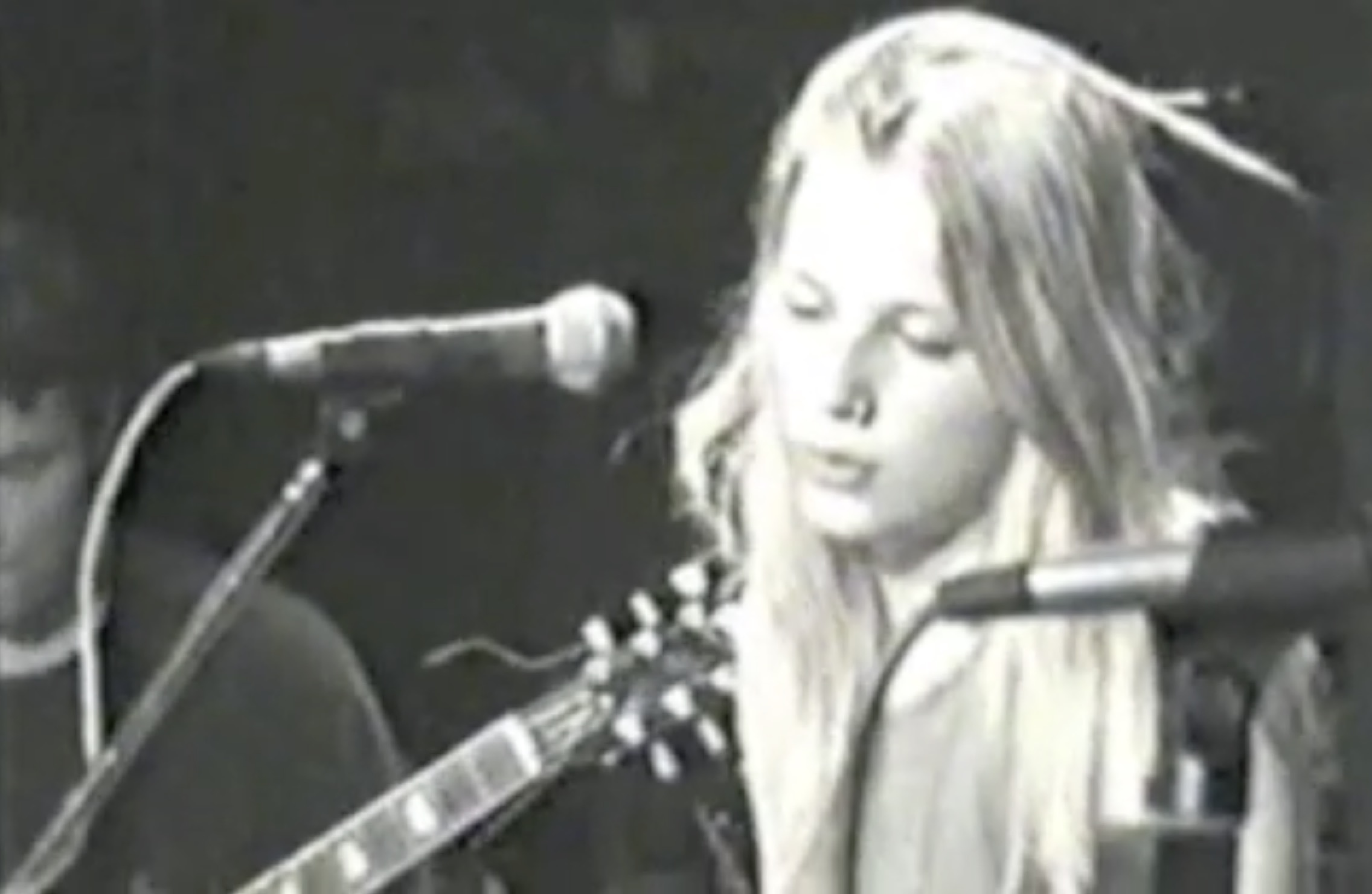
    Teenage artist, singins.
    The author as a rockin’ teenager.

    At the time, I was kind of oblivious — once again — to how unusual this was.
    Doesn’t everyone’s life do this kind of thing?

    If it hadn’t been for that wonky teacher with his performance of “Alice’s Restaurant” for a random class of ten year olds, the street musician with no perspective on what to do with a talented thirteen year old, and my incredible bandmates — I wouldn’t have ended up in the States.

    Someone in the business of sending musicians to school heard those band recordings years later, and decided to help send me off to music college in New York City.

    But — through this all — I didn’t learn how to be an artist. I always was one.
    Even today, I am not sure about how “tame” I want my talent to be.

    I have done my fair share of study since, and I truly enjoy honing my craft as a writer, storyteller, dancer, musician — whatever my endeavor.
    But all that training is for only one purpose.

    So that when it comes time to create, I am not thinking.
    When that creative valve opens, I can “just do”.

    Inspiration works best when I create from the place of not knowing. Of accepting whatever wants to “download” from the universe, through this ecstatic conduit that I am so fortunate to be in charge of keeping clear of detritus and baggage.

    Because that contagious spark that all great art ignites — it doesn’t come from any one of us.

    It belongs to all of us, equally. It exists to be shared.

    We, artists, live to create for our audiences. To pass on the inspiration we receive from the universe on to other people. The art is ours, but the inspiration isn’t.
    That spark comes from a place greater than us, flows out beyond the boundaries of our selves and — through our art — affects people in ways we can’t control.

    It resonates differently in each person receiving. It changes people.

    And by changing those people, it changes the world.

    We, artists, are merely humble stewards of our mortal shells as conduits — as the living portals through which the eternal flame springs.

  • What is worth building?

    What is worth building?

    My decades as an hourly consultant have conditioned me to calculate the monetary return of any time investment almost subconsciously. So, when I was asked to create an art installation, my first thought was “I don’t have time for this”.
    As in I can’t spare the time because billable hours should always take priority.

    But at the time, I also had a once in a lifetime pile of objects about my abode. I’d just finished an archiving project for an artist whose house had burned down some years back, but whose hard drives containing the masters of all their recordings miraculously survived the fire.

    Spin platter “old school” hard drives are less used now, and I was about to recycle a pile of them, so I thought: “When’s the next time you’ll get to pull those cool looking read heads and shiny platters out of a bunch of drives?”
    So, I said yes to creating the installation.

    The prompt was “Becoming”.

    It made me think of how we put things into categories. Hard drives are “dead technology”. Plants are “living things”, “weeds”, “food”.
    Art is usually not made of either.

    And it made me think of the lifecycle of these particular hard drives. How they were made, bought to store the only copies of an artist’s life’s work. How, for that time, their lifeless form was imbued with an intangible value that caused the artist, as they fled their burning house with nothing but the literal shirt on their back, to pray something of their life’s work would survive.
    And how — by nothing short of a miracle — only that room in the house didn’t burn to ash, and was not soaked by firefighters.

    The scraggly boxes were brought to me covered in soot.

    Some of the drives needed a little help, but nearly all of the data came off them intact.

    Once that they had performed their miracle, I thoroughly erased the drives. Overwrote every formerly meaningful block with random data. Making them, once again, lifeless — and most literally, meaning-less.
    Stripped of their recording studio markings and labels, the empty shells were now ready for recycling.

    It made me think about where the drives would end up and what lived there.
    I imagined weeds intertwined with the rusted, bent drive heads someplace “away”.

    In addition, I had some computers that were no longer viable in today’s rapidly changing technological landscape. Ten years old is ancient, even for a formerly top of the line machine. The churn of material. Of energy. Of discards.

    I opened some of them up, searching for cool looking parts.
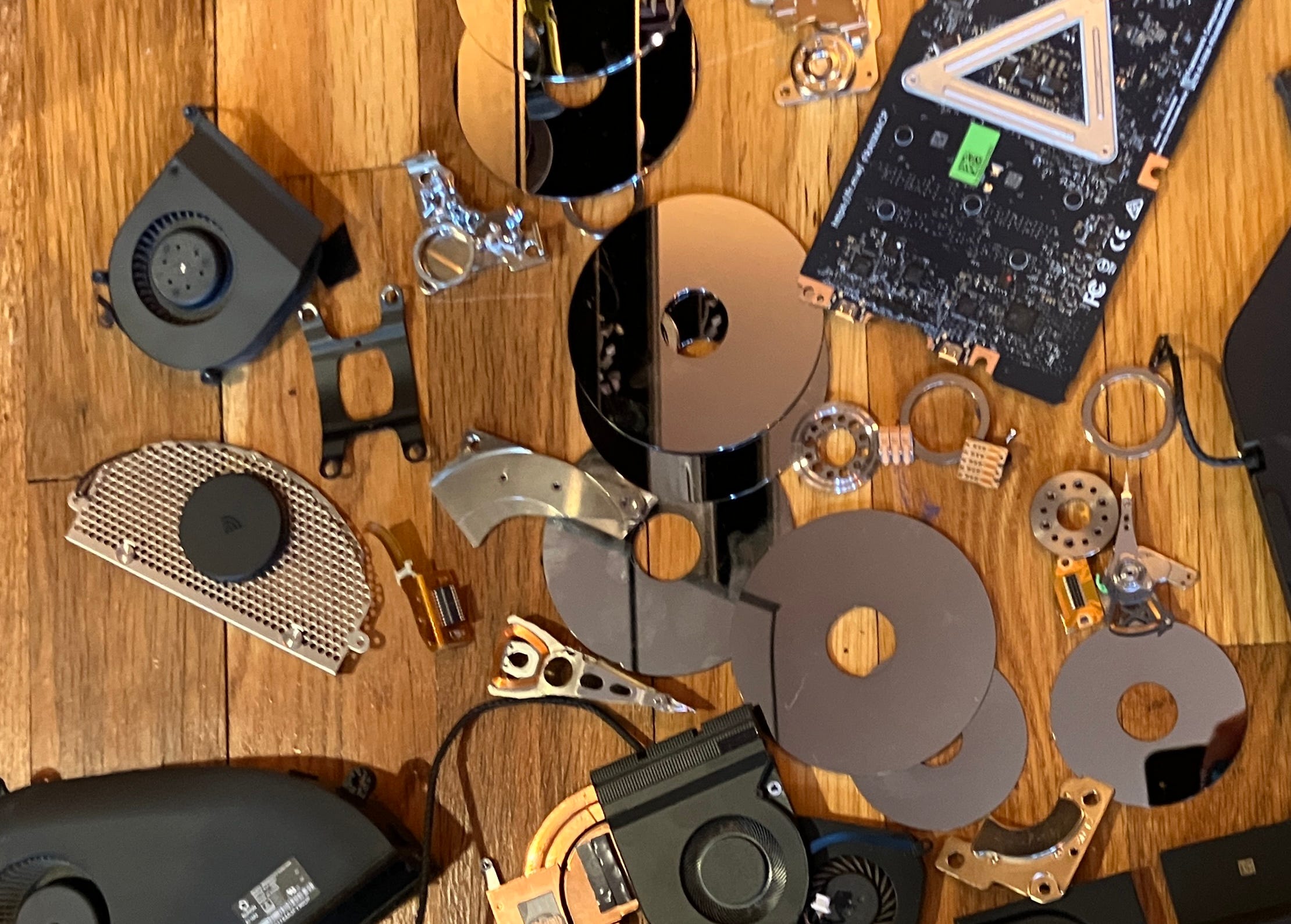
    A speaker here, a wifi antenna there. A CPU heat sink. A hinge.

    Computer parts on the floor.

    I’ve always been fascinated by the way modern devices look on the inside. It’s a different world in there from the sleek, “best foot forward” external shell. You can tell which electronics had been designed for easy repair versus those the manufacturer would rather you replace at the first malfunction. Some you can take apart intuitively, because the inner layouts make sense. Others are head scratchers. Labyrinths of poor engineering and little concern for the future.

    I imagine a machine that would come apart neatly into all the separately reusable/recyclable components. I have yet to meet one that does. I would gladly take apart the machines I use for better recycling.

    I wanted to build some sort of “fluid” frame to contain the scavenged mechanical parts. I wanted it to look alive, as if it had grown, not been assembled.
    Then, one of my plants caught my eye.

    Malabar spinach vines in hydroponic garden.

    I had been playing with bonsai wire lately, to guide vining Malabar spinach plants towards my ceiling and offer structure to a droopy pride of India tree. Then I kind of started using it all over the place. To hold air ducts. To make little hooks to attach ankle straps to a pair of stilettos that kept sliding off my heels.

    So I took a block of wood and fastened it to a small pedestal. Put in some angle brackets and looped bonsai wire through the screw holes. OK. This looked like a bizarre antenna, all crooked and wobbly.

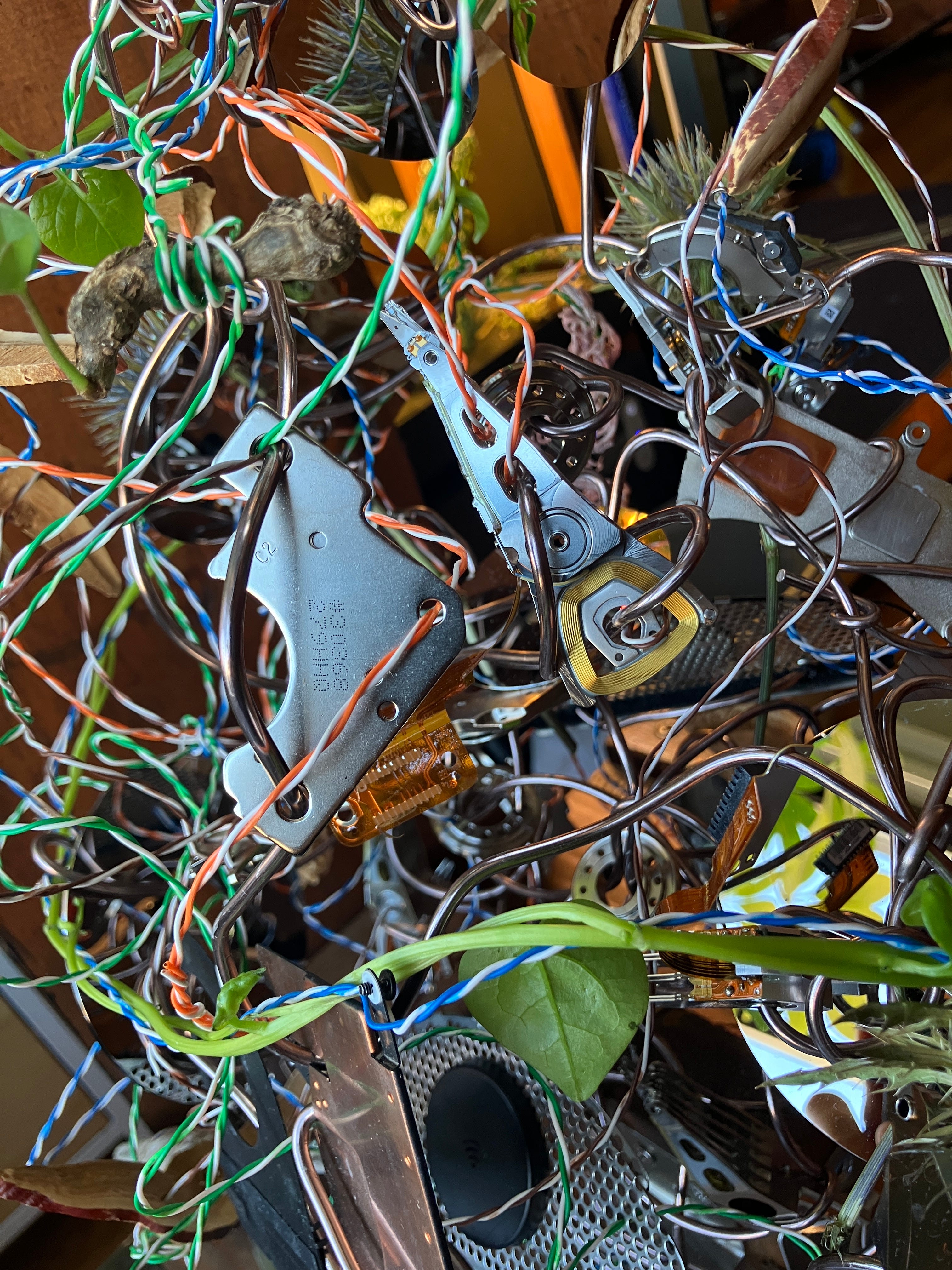
    Then I began threading hard drive and computer parts onto the bonsai wire. Spinning up and up in a spiral, weaving in and out. Using the hard drive magnets to “pin” bits together. I felt like a kid doing this, guided by a randomness that we seldom get to channel when making things. Usually, there is a purpose, a problem to solve.

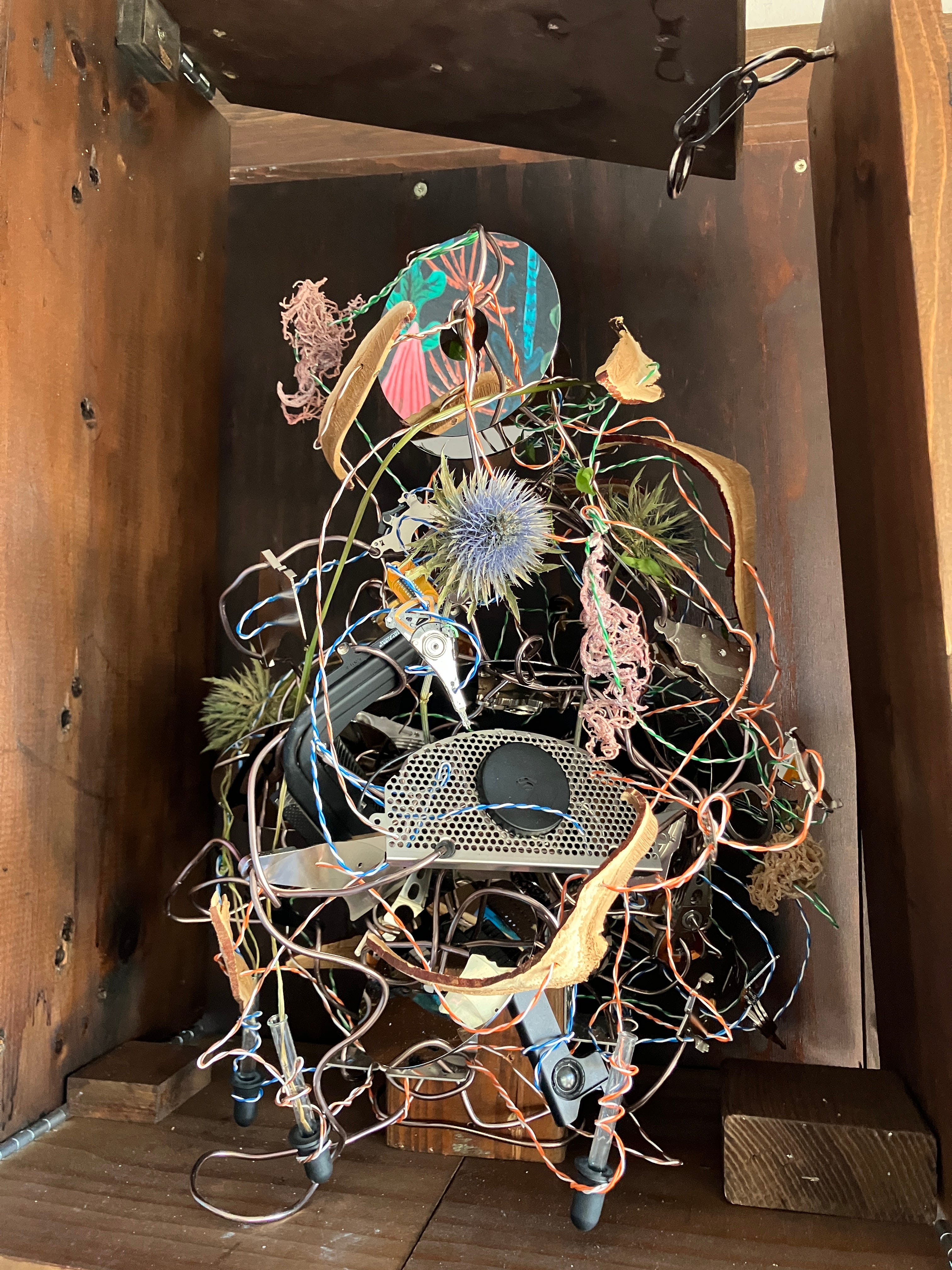
    What emerged looked like a robot vomited their innards into a pile after a bad meal. Kind of organic looking, but still all composed only of shiny metal forms. All dead.

    Then, I remembered I had some herbal provisions, too old for medicinal use, so I sliced up some Ethernet cable and wove it through the bonsai wire, pinning reishi mushroom slices, sea moss clusters and nettle blooms through the structure.

    Now, it began to feel closer to what I was hoping for.
    It began to look like it grew from the ground like that, on an Earth where hard drive parts grew on thorn bushes.

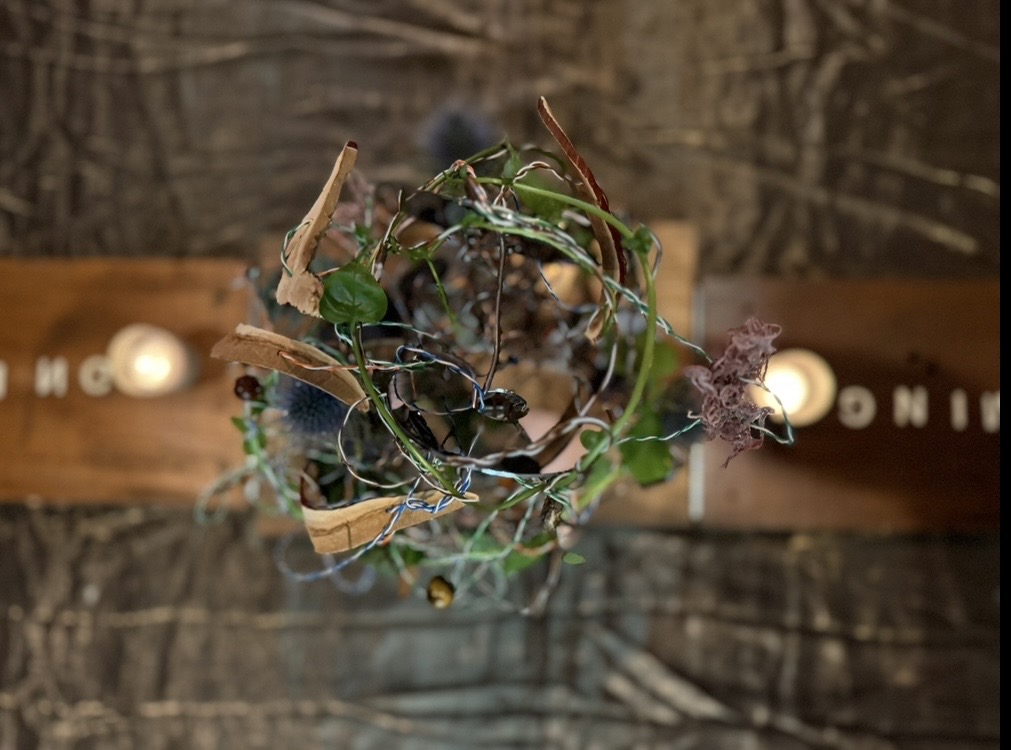
    Close-up of art installation.

    The last portion was inspired by a hydroponic housekeeping task. My Malabar spinach vine had been growing for six months straight, and was beginning to strain against the size of its home. After a point, the root structure becomes so large as to take up every bit of available space, leaving no room for water to move, and the plant’s own growth begins to starve it — and any plants downstream — of nutrients.

    So, I devised a temporary vase from a tincture dropper, and placed a section of living vine inside the piece. I knew it would only live about a week, but the living structure would dry to become part of the piece.

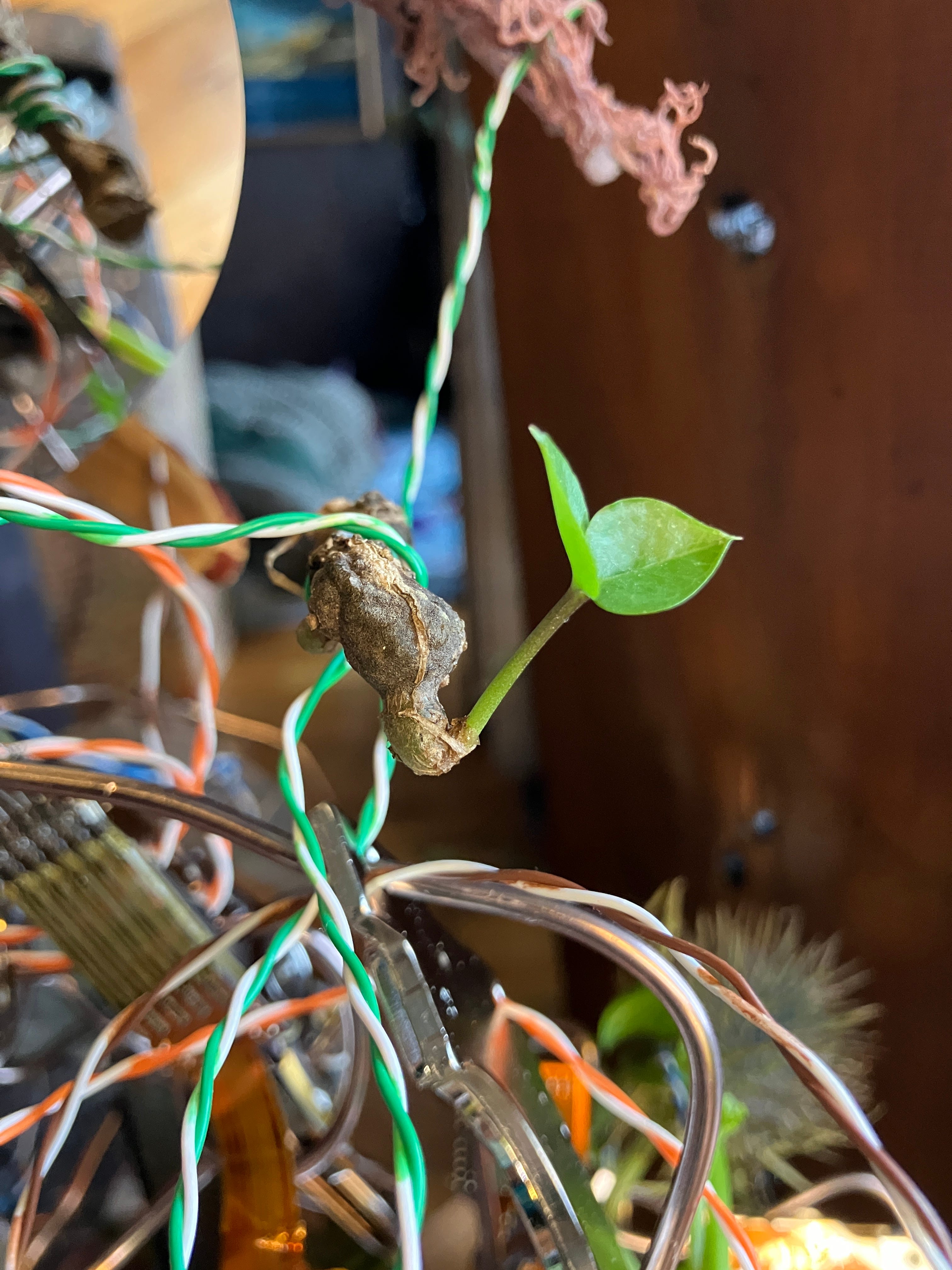
    There was a tiny plant, whom I named Kevin, set aside in a jar. Kevin had a bulbous root and only two leaves for over a year. No matter what I did, Kevin stayed the same. So, I added Kevin to the piece. Figured he wouldn’t mind. I’d take him back out later.

    Kevin, the little plant.

    Lastly, I constructed a frame to contain and transport the piece out of scrap lumber, with a hefty wooden boat handle on top for carrying. The frame unfolds to its sides for installation.

    Now… Was this all worth doing? Was what I’d built needed in the world?

    All I can say is that the creation made me think about much I otherwise wouldn’t have. I will never get paid for the time it took in cash. But what I got in return for the effort was priceless.

    I remembered, once more, how cool it is to not know what you’re building, and to see it happen in front of your eyes as one idea leads to the next.
    There is something in that process that reminds me our future is never what we think it will be. Because, for all of us, this same process is unfolding all the time. Each decision leads to the next, and there is no brain among us who can foresee it all.
    Where would be the fun in that?

    So, yes.
    If for no other reason than my own catharsis, this weird thing was worth building.

    Full view of the final art piece.

    I wrote an “art statement” to go with the piece, which was nice to think about as well:

    The “away” in throwing away is a lie.
    There is no such magical place.

    When we discard something poisonous or sharp, something difficult or impossible to digest, someone, something — or generations of them — have to live with it around and inside them. And it changes how they move, how they grow.

    So when we find daggers in our own food, this is where they come from.

    When we throw daggers, bullets, missiles, punches—

    They never hit what we’re aiming for.